Short answer: ETBUS (engaged in a trade or business in the United States) is the test that decides whether the US taxes your LLC’s profit. It turns on where your activity physically happens, not on where your clients are or where your bank is. Most non-resident owners running a service business from outside the US are not ETBUS. That means no US federal income tax on the profit, and it does not mean the profit is untaxed anywhere.
If you want the wider picture first, US tax for non-resident LLC owners covers how the whole thing fits together.
What the test is actually asking
A single-member LLC owned by a non-resident is normally a disregarded entity. The IRS looks straight through it to you, which means the question is never “does the LLC owe tax” but “does this non-resident individual have income the United States can tax.”
For business profits, the gateway is ETBUS. If you are engaged in a trade or business in the United States, income effectively connected with that business (effectively connected income, or ECI) is taxed by the US at graduated rates, and you file a US personal return. If you are not, that profit generally falls outside the US net entirely.
So the whole thing reduces to one question: are you conducting business inside the United States, or are you conducting business outside it that happens to involve Americans?
Those two sound similar and they are completely different.
The three factors that actually decide it
There is no statutory checklist, which frustrates everybody. The test is facts and circumstances, and the case law has settled around activity that is considerable, continuous and regular. In practice, three things drive the answer for the businesses we see.
One: where the work is physically performed. For services, the source generally follows the person doing the work. A developer writing code in Lisbon, a consultant advising from Dubai, a designer working from Buenos Aires: the service is performed where they sit. The client’s location does not move it.
Two: whether you have a fixed place of business in the US. An office, a warehouse, a leased facility. A registered agent’s address is not this. A virtual mailbox is not this. A place where the business actually operates is.
Three: whether you have dependent agents in the US. Someone in the United States acting on your behalf, with authority to negotiate or conclude contracts, is a strong indicator that the business is being conducted there. An independent contractor performing a discrete task is a different case from an employee or a person representing you commercially.
If all three point outward (you work abroad, you have no US premises, nobody in the US acts for you), the ordinary conclusion is that you are not ETBUS.
The things people think trigger it, but do not
US clients. The most persistent myth in this entire category. Selling to Americans is not conducting business in America. If it were, every exporter on earth would be filing US returns.
A US bank account. Where you keep money is not where you conduct business. Banking is a consequence of the structure, not a determinant of your tax position.
A US LLC. Forming the entity does not create the activity. A Wyoming LLC operated entirely from abroad is a US entity conducting a foreign business.
A US registered agent and address. A required legal service, provided by a company whose job is to receive documents. It is not premises.
A US phone number, a .com domain, or invoicing in dollars. None of these is an activity. They are appearances, and the test is not about appearances.
Stripe or a US payment processor. A payment rail is not a place of business.
The things that genuinely can trigger it
Spending significant working time physically in the US. This is the one that catches people who believe none of the above applies to them. If you spend months of the year in the United States doing the work, the argument that the activity happens abroad gets much harder to sustain. There is no clean day-count rule for ETBUS the way there is for personal residency, which makes it more dangerous rather than less.
Hiring US-based staff. Employees in the United States performing your business’s core work are a strong signal.
A dependent agent with contracting authority. Someone in the US who can bind you commercially.
Holding inventory in the US. Particularly relevant for e-commerce and FBA sellers. Goods sitting in US warehouses, sold to US customers, is a materially different fact pattern from a services business run from abroad, and it interacts with sales tax rules as well.
Real property. US real estate has its own source rules that do not depend on this analysis at all.
Whether a specific pattern of US presence, staffing or inventory crosses into ETBUS is a facts-and-circumstances determination: anyone near the line needs an opinion from a US tax adviser on their own situation, and nothing here substitutes for one.
ETBUS is not the same as tax free
The most damaging thing done with this concept is the leap from “not ETBUS” to “0% tax.”
Not being ETBUS means the United States does not tax that business profit. It says nothing whatsoever about the country where you are tax resident, which taxes you under its own rules and has never heard of ETBUS. If you live somewhere that taxes worldwide income, that profit is taxable there whether you distribute it or leave it in the account.
There is a second layer people miss. Even a non-ETBUS structure can have US-source income of other kinds: US-source dividends, for instance, are subject to withholding regardless of the ETBUS question, at a rate that depends on the treaty between the US and your country of residence.
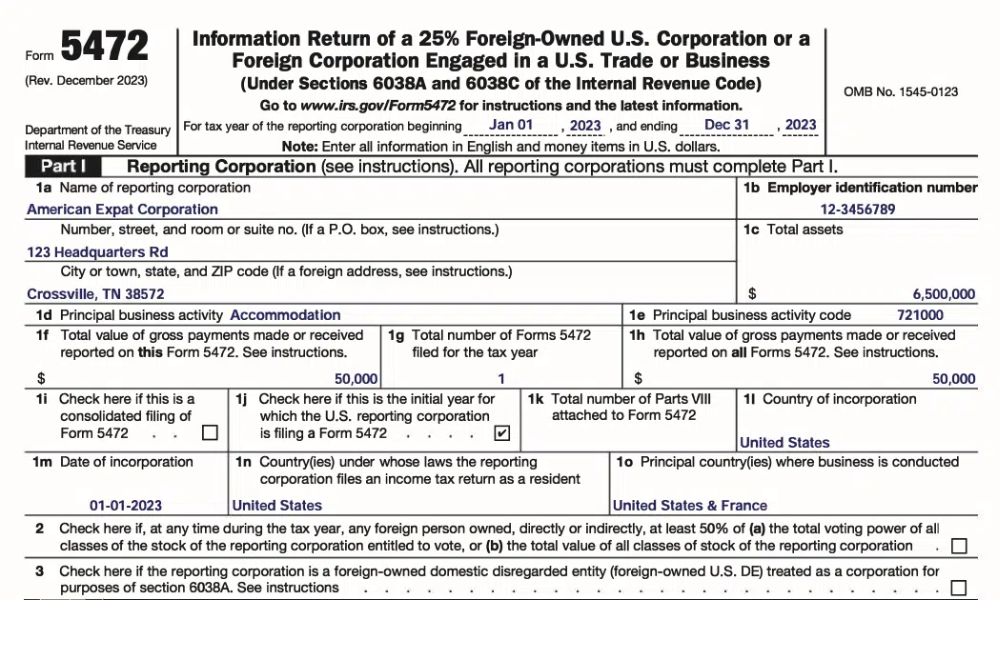
And a third: your obligations do not disappear. The Form 5472 and pro-forma 1120 are owed annually by a foreign-owned single-member LLC no matter what the answer is. The penalty is $25,000 and it applies to companies with no income and no activity.
The honest summary is that ETBUS is a question about which country taxes you, not a question about whether you are taxed. Anyone presenting it as the second is selling you something.
How this plays out in practice
The consultant. Lives in Portugal, works from home, all clients in the US, no US presence of any kind. Not ETBUS on the ordinary analysis. Pays no US federal income tax on the profit, pays Portuguese tax on it, files Form 5472 annually. The structure gives clean dollar banking and vendor credibility, which is what it was for.
The agency owner with a US hire. Lives in Spain, has a salesperson in New York who negotiates and closes contracts. This is a genuinely different situation. The dependent agent question is live and needs a real determination, because the answer changes the filing profile substantially.
The FBA seller. Lives in Colombia, inventory in US fulfilment centres, selling to US buyers. Inventory in the country is a fact pattern with weight, and this seller has sales tax nexus questions running alongside. Not a case to resolve with a rule of thumb.
The trader. Buys and sells securities for their own account from abroad. There is a specific safe harbour for trading securities for one’s own account that generally keeps this outside ETBUS, which is one of the reasons our answer to traders is usually that the entity does very little for them.
The nomad. No settled residency, moves constantly, spends four months a year in the US. This person has two problems, and ETBUS is the smaller one. The residency question comes first.
What to do with this
If you run a service business from outside the United States with no US premises, staff or agents, the ordinary conclusion is that you are not ETBUS, and the practical consequence is that your tax conversation belongs in the country where you live rather than in the US.
If any of the triggers apply to you (real time spent working in the US, US staff, inventory, property), do not resolve it from an article. That includes this one. Get a determination for your facts, because the cost of being wrong is a US filing obligation discovered late plus penalties, and the cost of asking is an hour of a professional’s time.
And whichever way it lands, file the 5472. It is the obligation that does not care about the answer.
If you want the reasoning applied to your own case before speaking to anyone, the assessment walks it and gives you a written result.
Frequently asked questions
If my LLC is not ETBUS, do I pay no tax at all?
You pay no US federal income tax on that business profit. You almost certainly still pay tax where you are tax resident, because that country taxes your income under its own rules regardless of what the US concludes. ETBUS answers one question (does the United States get to tax this) and it is not the question that determines your actual bill.
Does having US clients make me ETBUS?
No, and this is the most common misunderstanding. Who pays you is not the test. Where the activity happens is. A consultant in Lisbon serving only US clients is generally not conducting business inside the United States, however American the client list looks.
Does a US bank account or a US address make me ETBUS?
On their own, no. A bank account is where money sits and a registered agent address is a legal service, not a place of business. Neither constitutes conducting a trade or business in the United States. Problems arise when the address is presented as an operating office it is not.
Do I still file if I am not ETBUS?
Yes. A foreign-owned single-member LLC files Form 5472 with a pro-forma 1120 every year regardless of ETBUS status, income or activity. The penalty for missing it starts at $25,000 and it applies to companies that owed nothing and did nothing.
Who decides whether I am ETBUS?
Ultimately the IRS, on the facts. It is not a box you tick or a status you elect, and no provider can grant it to you. What you can do is understand the factors, be honest about your own situation, and get a determination from a US tax adviser when your case is anywhere near the line.