An LLC that is not maintained is not an asset. It is exposure with a filing address.
The founders who get hurt are almost never the ones who did something aggressive. They are the ones who formed an entity through a checkout, never heard the words “Form 5472”, and found out three years later: usually because a bank asked, or a client’s due diligence did.
This is the compliance side of a US LLC held by a non-resident owner: what has to be filed, when, and what the failure actually costs.
The filing nobody warned you about
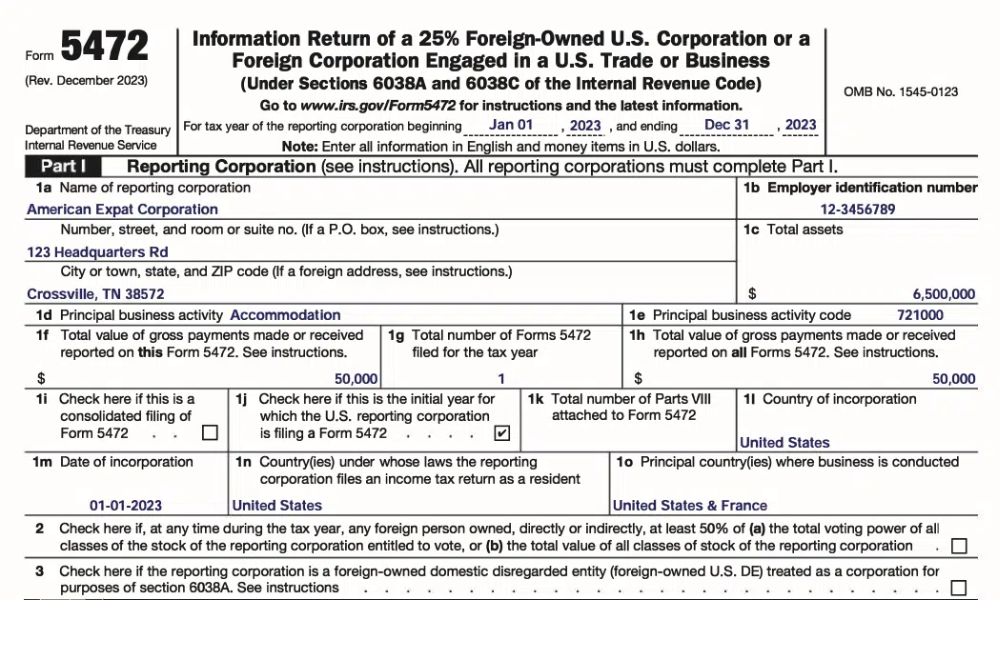
Every foreign-owned single-member LLC must file Form 5472, attached to a pro-forma Form 1120, every single year. It reports transactions between you and your own company: contributions, distributions, loans.
The penalty is $25,000 per year, and it is automatic. Not a ceiling a judge might reach: the starting figure.
Three details that make it worse than it sounds:
- It is due even with zero revenue. No activity does not mean no obligation.
- It is due even when no tax is owed. Filing and paying are different things.
- It cannot be e-filed. Mail or fax to Ogden, Utah. Deadline 15 April, extendable to 15 October with a Form 7004 filed on time.
If a provider formed your LLC and never mentioned this, that tells you what kind of provider they are.
Form 5472, field by field
The form itself is short, but every field maps to a specific piece of information the IRS wants on record, and inconsistency between fields is a common, avoidable trigger for correspondence back from the IRS.
Part I: the reporting corporation, your LLC’s legal name exactly as filed, its EIN, and the registered agent’s address (not a PO box). Part II: the related party, that is you: full name, country of tax residence, ownership percentage (100% for a single-member LLC), and your relationship to the entity (owner). Part III: monetary transactions with the related party, the section that actually matters, where every “reportable transaction” between you and the LLC gets classified by type and amount.
What counts as a reportable transaction is broader than most founders assume, and this is where the most common filing error happens: assuming “I had no transactions” when what actually happened is “I had no sales.” Capital contributions (depositing money to open the bank account), distributions (moving money from the LLC to yourself), loans in either direction, and intercompany payments between entities you control all count. Depositing $5,000 to open the account, later withdrawing $3,000 for personal use, or lending the LLC $10,000 for inventory are each reportable transactions in their own right, regardless of whether the LLC invoiced a single client that year.
What does not require the 5472 is a year with genuinely zero transactions of any kind between you and the entity: no contributions, no distributions, no loans. That is rare in practice, because opening the bank account itself typically involves an initial deposit that counts as a contribution.
| Transaction type | Example |
|---|---|
| Capital contribution | You deposit $5,000 to open the LLC’s bank account |
| Distribution | You transfer $3,000 from the LLC to your personal account |
| Loan to the LLC | You lend the LLC $10,000 to buy inventory |
| Loan repayment | The LLC repays the $10,000, with or without interest |
| Intercompany payment | Your LLC pays another entity you control for services |
| Asset contribution | You contribute a laptop or other equipment you already owned |
Each of these, on its own, is enough to make the filing mandatory for that year: there is no minimum dollar threshold below which a reportable transaction stops counting.
The pro-forma 1120 and Ogden
Because a foreign-owned disregarded entity does not file a standard corporate return, the Form 5472 travels attached to a pro-forma Form 1120: a cover form that essentially states “this is a foreign-owned US disregarded entity; the attached 5472 reports its transactions.” The top of that pro-forma should be marked clearly to signal it is not a standard corporate filing, alongside a short attachment statement identifying the entity, its sole owner, their country of residence, and confirming there was no US trade or business activity generating federal tax liability (where that is the case).
Submitting the 5472 without the pro-forma 1120 attached is incomplete: the package is both forms together, not either one alone. And critically: this cannot be filed electronically. It goes by mail or fax to the IRS service center in Ogden, Utah, which catches almost every founder used to e-filing everything else in their financial life. Plan for postal or fax transit time rather than discovering the requirement on 14 April.
The Form 7004 extension, and what it does not cover
Filing Form 7004 before the original 15 April deadline buys an automatic six-month extension, pushing the 5472 and pro-forma 1120 deadline to 15 October. It requires no justification and is genuinely automatic, but it extends the filing deadline only. If you owed any US federal tax (which most non-resident owners with no ETBUS do not), the extension does not extend the deadline to pay it; interest and penalties on unpaid tax can still accrue from the original date. For the large majority of founders reading this guide, whose obligation is purely informational with $0 owed, that distinction is academic, but it is worth stating precisely rather than assuming the extension covers everything.
Behind on filings? How abatement works
If you have gone one or several years without filing, the honest first step is establishing exactly which years are missing and what the exposure actually is: the $25,000 penalty stacks per year, so three missed years is a potential $75,000 exposure, not a one-time hit.
The path forward is filing the outstanding years rather than waiting for the IRS to notice, and, where the facts genuinely support it, requesting reasonable cause abatement: a formal argument, generally prepared with a CPA or tax attorney, laying out the facts of what happened, why it happened, and what corrective steps have been put in place (a new accountant, a filing calendar, the outstanding forms filed alongside the request). Reasonable cause is not automatic and is not guaranteed, but the IRS does have a real mechanism for it, and a well-documented, proactively filed request is treated very differently from silence that only ends when a notice arrives. What does not work as a strategy, in any version of this: continuing to not file and hoping it goes unnoticed. It is the one approach that reliably fails.
The state-level and IRS-level costs of catching up scale roughly with how long an entity has been neglected. As an illustration only (actual figures depend on the state and your specific facts), one year of a lapsed annual report in a low-cost state plus a reinstatement fee is a comparatively small sum; three years of the same, stacked with three years of unfiled 5472s before any abatement is considered, moves the exposure into tens of thousands of dollars almost entirely from the federal penalty rather than the state charges. The state-level cost of neglect is nearly always manageable on its own. The federal penalty is what turns a minor oversight into a real problem, and it is also the one most amenable to correction if you act before the IRS acts first.
Not sure how this applies to your case?
Eleven questions and we tell you whether the LLC fits, and if it does not, that too.
State-level maintenance
Beyond the IRS, the state that issued your entity wants to see signs of life every year, and the specifics vary meaningfully state by state:
- Wyoming: an annual report due in the anniversary month of formation, with a modest minimum fee (roughly $60 for a small LLC). Missing it does not trigger an immediate fine, but continued non-compliance leads to administrative dissolution.
- New Mexico: no annual report and no franchise tax at all, which is a large part of why it appears alongside Wyoming so often in formation comparisons for non-residents. The federal Form 5472 obligation still applies regardless.
- Delaware: a flat $400 annual franchise tax for LLCs, due 1 June, owed whether the entity billed nothing or eight figures. It was $300 until HB 400 raised it for the 2026 tax year; corporations were not affected. That flat charge is exactly why Delaware rarely makes sense for a founder with no investors and no reason to be there specifically.
- Florida: an annual report with its own fee and deadline, escalating to a late fee if missed, and administrative dissolution if it goes unaddressed long enough.
The consequence for ignoring any of these is the same shape everywhere: a warning period, then escalating fees or loss of good standing, then, if nothing changes, administrative dissolution.
The registered agent
The registered agent is the physical, in-state address that receives legal notices and official state correspondence on your LLC’s behalf: a lawsuit, a state notice, anything requiring formal service. It has to be current, continuously, with no gaps.
When it lapses, the state loses its ability to reach your entity. Notices are generally considered delivered whether or not you actually receive them, so a lapsed agent does not pause your obligations: it just means you find out about problems later, and often worse, than you would have with a live agent in place. Left unaddressed, a lapsed registered agent is itself a path toward administrative dissolution, and separately, if the LLC is ever sued and cannot be reached through its registered agent, a court can enter judgment against it by default without you ever knowing the case existed. A registered agent typically costs a modest amount annually: it is one of the cheapest line items in maintaining the entity and one of the most consequential to let lapse.
Administrative dissolution and reinstatement
Administrative dissolution is what happens when a state, after unaddressed non-compliance (an unpaid annual report, a lapsed registered agent, an unpaid franchise tax) formally cancels the entity’s authority to do business. It is not usually instantaneous; states generally provide notice periods first. But once dissolution happens, the entity can no longer legally sign contracts, invoice, or operate, and the liability protection that was the whole point of forming an LLC weakens considerably if you continue operating as though the entity still existed.
Reinstatement is generally possible within a defined window (commonly a period of a year or more, depending on the state) by filing the outstanding annual reports, paying the accumulated fees, and paying a separate reinstatement fee. The longer dissolution goes unaddressed, the more expensive and complicated the reinstatement becomes, and during the entire dissolved period the entity is not legally operating, which is precisely when a bank or a client due-diligence review is most likely to discover the problem.
BOI: where it stands now
The beneficial ownership reporting requirement caused genuine panic in 2024. It no longer applies to you. FinCEN’s final rule, announced on 11 August 2026 and effective on 14 August 2026, permanently exempts companies formed in the United States from beneficial ownership reporting under the Corporate Transparency Act, adopting the March 2025 interim rule with limited changes. The obligation now reaches only foreign-formed entities that register to do business in a US state.
The distinction that decides your position is where the company was formed, not who owns it. A Wyoming or New Mexico LLC owned entirely by a non-resident is a domestic reporting company and is exempt. If you filed a report in 2024, there is nothing to withdraw or update, and FinCEN has said it will remove that information from the database itself.
This rule has now moved three times in three years, which is why we still confirm the position annually rather than treating it as settled forever. The full explanation of what changed covers the sequence and the one case where a filing obligation does survive.
Two scenarios, worked through
The founder who assumed no revenue meant no filing. A services business ran for two years on the assumption that “since I don’t owe US tax, I don’t have to file anything.” No Form 5472 was ever submitted, and the exposure reached two years of the automatic penalty: a potential $50,000 before any reduction. The fix was filing the missing years alongside a documented reasonable-cause request rather than continuing to wait. The lesson generalises: the 5472 obligation is triggered by transactions with the entity, not by revenue, and it applies whether the LLC billed a million dollars or nothing at all.
The LLC left dormant after the founder moved on to something else. An entity stopped being used but was never formally closed: no annual report, no registered agent renewal, nothing. Eighteen months later it had drifted into administrative dissolution without the founder noticing, discovered only when a new bank inquiry needed a certificate of good standing that no longer existed. Reinstatement meant filing the missed annual reports, paying the reinstatement fee, and losing weeks in the process. An entity you are not actively using still carries obligations for as long as it legally exists: the only way to actually stop them is a formal dissolution, not neglect.
What a fragile structure looks like
This is the ICP-specific risk that platforms never price in. Fragility is not about penalties; it is about what happens when someone competent looks closely:
- An enterprise client runs vendor due diligence and asks for the operating agreement. It is a template with your name inserted, describing governance that does not match how the company actually runs.
- A bank reviews the account two years in and finds filings overdue.
- A payment processor freezes settlement pending documentation you do not have assembled.
- Your home tax authority asks what this foreign entity is, and the answer needs to have been coherent from day one, not reconstructed under pressure.
None of those are edge cases. They are the normal life cycle of a business that grows.
The annual calendar
What “maintained” actually means, repeated every year:
| Obligation | Deadline | Applies to |
|---|---|---|
| Form 5472 + pro-forma 1120 | 15 April (15 October with a timely Form 7004) | Every foreign-owned single-member LLC |
| Form 1065 + Schedule K-1 | 15 March (with its own extension route) | Foreign-owned multi-member LLCs |
| State annual report | Varies by state; none in New Mexico | Depends on state of formation |
| Franchise tax | Annual, where the state charges it (e.g. Delaware’s $400) | Depends on state |
| Registered agent renewal | Continuous: before it lapses, not after | Every LLC, every state |
| Structural review | Once a year, alongside the filings above | Every LLC held by a non-resident |
That last line is easy to skip and matters more than it looks: has your tax residency changed? Has your activity changed enough to touch ETBUS? Are you now dealing with counterparties who will ask for documentation you have not updated? A structure that fitted two years ago may not fit now, and the annual filing cycle is the natural moment to check.
That calendar is included in what we do rather than sold back to you in year two. If you inherited a structure and do not know which of these were filed, switching your LLC begins with that audit.
In short
A non-resident LLC carries a small number of obligations with disproportionate consequences: Form 5472 with its automatic $25,000 penalty, state maintenance that keeps the entity alive, a registered agent that must never lapse, and a BOI requirement that no longer reaches US-formed entities at all. None of it is complicated. All of it is unforgiving if nobody owns it.
Explore the full guide
Frequently asked questions
Do I have to file if my LLC made no money?
Yes. Form 5472 with a pro-forma 1120 is an information return, not a tax return. A foreign-owned single-member LLC files it whether it invoiced a million dollars or nothing at all. Zero activity does not mean zero obligation, and the $25,000 penalty applies just the same.
Can Form 5472 be filed electronically?
No, and this catches almost everyone. It goes by mail or fax to the IRS office in Ogden, Utah. In 2026, by fax. Plan for the transit time rather than discovering it in April.
Does filing in the US mean I owe US tax?
Filing and paying are separate questions. Most non-resident owners with no US presence owe no federal income tax because there is no ETBUS, but they still must file. See our guide on US tax for non-resident LLC owners for where that line sits.
What happens if I have missed several years?
The penalty stacks per year, so three missed filings is potentially $75,000. It is not a comfortable conversation, but it is a solvable one: the correct move is to file the outstanding years and, where the facts support it, request abatement for reasonable cause. Ignoring it is the only strategy that reliably fails.
Do I still need to file a BOI report?
No, if your LLC was formed in a US state. FinCEN's final rule, announced on 11 August 2026 and effective on 14 August 2026, permanently exempts domestic reporting companies from beneficial ownership reporting, adopting the March 2025 interim rule with limited changes. The obligation now reaches only foreign-formed entities registered to do business in the US. The exemption follows where the company was formed, not who owns it, so a non-resident owner of a Wyoming LLC is covered. See our full explanation of the rule.