Short answer: an unmaintained LLC does not quietly disappear. It loses good standing, gets administratively dissolved by the state, keeps accruing a federal information-return obligation with a $25,000 penalty attached, and takes your banking and payment processing down with it. Every stage is cheaper to prevent than to fix, and abandonment is the most expensive option available.
The order it actually happens in
Neglect follows a predictable sequence. Recognising which stage you are at determines what to do.
Stage one: the registered agent lapses. Usually the first domino, and almost always because a renewal notice went to an email nobody reads. It is the cheapest item on the whole list and losing it is disproportionately damaging, because the agent is who receives official notices from the state, including the ones warning you about everything that follows.
Stage two: the state filing is missed. Whatever your state requires (an annual report, a franchise tax, a periodic statement) goes unfiled. Late fees begin. In New Mexico there is nothing to miss, which is one of the genuine arguments for it as a state choice.
Stage three: delinquent status. The state marks the entity as not in good standing. This is publicly visible, and it is the point where third parties start noticing: a bank during a periodic review, a client running due diligence, a marketplace re-verifying your seller account.
Stage four: administrative dissolution. The state ends the entity’s existence. You now have a company that legally is not one, while its obligations continue.
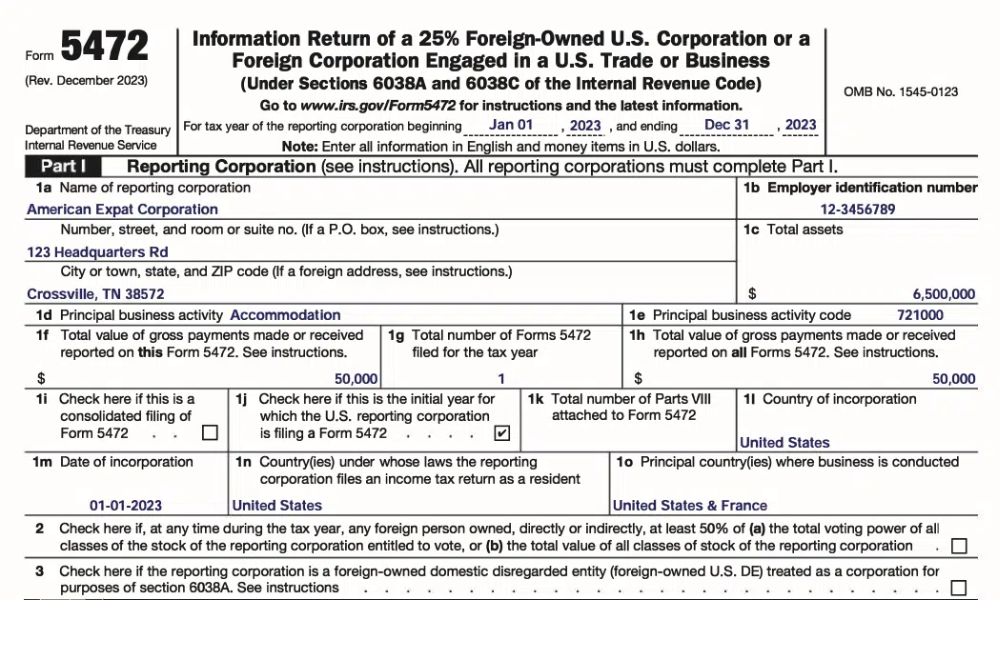
Stage five: the federal penalty. Independent of every stage above and by far the largest number. The Form 5472 with pro-forma 1120 is owed annually by a foreign-owned single-member LLC, regardless of income, activity, or whether the state dissolved the company. The penalty starts at $25,000 per year.
Note the shape of that sequence: the cheap failure at stage one is what prevents you hearing about stages two through five.
What breaks in the real world
The legal consequences are the smaller half. The operational ones arrive faster.
Banking. Banks re-verify. An entity that is not in good standing may have its account frozen or closed, and a closure reported to industry databases makes the next account harder to open.
Payment processing. Processors verify entity status too. A frozen settlement is a business-stopping event, and it usually happens at the moment volume is highest because that is what triggers a review.
Marketplaces. Amazon and similar platforms re-run seller verification. A suspended seller account with inventory in warehouses accruing storage fees is the worst version of this, and it is caused by paperwork rather than by anything commercial.
Contracts. Clients running due diligence ask for a certificate of good standing. Not having one stalls a deal, and it raises a question about everything else you have told them.
The liability shield. The separation between the business and your personal assets depends on the entity existing and being operated as a real company. A dissolved entity with commingled finances offers very little.
Selling the business. An FBA or e-commerce business with a compliance gap either does not sell or sells at a discount that dwarfs the cost of having stayed current.
Why this happens to sensible people
Almost nobody decides to neglect a company. Three patterns cause nearly all of it.
Nobody told them the obligations existed. The most common cause by a distance. A formation product that stops at the certificate leaves the buyer believing the job is done. The 5472 in particular is invisible until it is a penalty notice.
The business went quiet and the entity was forgotten. A project that did not work out, revenue that stopped, attention that moved elsewhere. The obligations do not pause for a dormant company, and dormancy is precisely when people stop paying attention.
The notices went to an address that stopped working. An old email, a former agent, a mailbox that fills up. Everything the state and the IRS would have told you goes to the address on file, and keeping that current is the whole job.
Catching up, in order
If you are already behind, the sequence matters and it is more recoverable than it feels.
One: find out what is actually true. Which state, what status, what was filed and what was not, whether the agent is current, which federal years are open. Guessing at this produces the wrong fix.
Two: restore the registered agent. Cheap, fast, and the prerequisite for hearing about anything else. It also often has to precede reinstatement.
Three: reinstate with the state. Most states allow reinstatement after administrative dissolution, generally by filing the outstanding reports and paying the accrued fees and penalties. There are usually time limits, after which you are forming a new entity rather than reviving the old one.
Four: file the outstanding federal returns. Including the pro-forma 1120 and Form 5472 for each open year. Filing late is materially better than not filing, and there are procedures for requesting relief where there is reasonable cause, which is assessed on the facts and is not automatic.
Five: rebuild the calendar. Every deadline dated, in a system you actually look at, with the notice address current. The US LLC tax calendar has an ICS per state with the 2026 and 2027 dates and the source of each.
Reinstatement windows, fee structures and the availability of penalty relief differ by state and by circumstance: a company with multiple open years should have a US tax adviser handle the federal filings rather than working from a general guide.
When closing it properly is the right answer
Sometimes the honest conclusion is that the entity should not continue. If the business ended, closing it deliberately is much better than letting it lapse.
A proper wind-down means settling liabilities, filing a final return, formally dissolving with the state rather than being dissolved by it, and closing the accounts. It costs something and it ends the obligations cleanly. The full sequence, with what each state charges, is in how to close a US LLC.
The alternative (abandonment) leaves an entity that continues to owe the annual federal filing, continues to accrue state consequences, and leaves you personally exposed to penalties on returns you never made. There is no version of walking away that is cheaper than closing properly.
The dormant company problem
The specific case that produces most of the damage, because it is the one where neglect feels reasonable.
A business does not work out. Revenue stops. You move on to something else. The entity sits there, doing nothing, costing nothing you can see. And every year it continues to owe the federal information return, and every year the state wants whatever it wants.
Three things make this worse than it looks.
Dormancy is not a status the obligations recognise. There is no filing you make that says “this company is asleep, stop asking.” The Form 5472 requirement attaches to a foreign-owned single-member LLC regardless of activity, and a company with no transactions still generally has something to report: the formation costs, any amount you put in, any fee you paid on its behalf.
Attention is exactly what a dormant company does not get. The notices go to an address you stopped monitoring, about a company you stopped thinking about. By the time anything reaches you, several years have compounded.
The penalty does not scale with the business. A company that earned nothing carries the same $25,000 exposure per year as one that earned a million. This is the single most disproportionate outcome in the whole category.
The right answer for a business that has ended is a deliberate wind-down, and it is cheaper than one additional year of drift. The wrong answer is the one almost everyone chooses, which is to do nothing and hope the entity ages out. It does not.
How this looks from the other side
Worth seeing it from the perspective of whoever is checking, because it explains why the consequences arrive when they do.
A bank during periodic review pulls the entity’s status from the state. Delinquent or dissolved is a red flag that is trivially easy to check and hard to explain away, and the account is frozen while you sort it out.
A payment processor does the same, and processors act faster than banks because their exposure is larger and their relationship with you is thinner.
A marketplace re-verifying a seller wants documents that agree with each other and with the public record. An entity that is not in good standing fails that check automatically.
A client’s legal team asks for a certificate of good standing as a matter of routine, and not having one raises a question about everything else in the vendor pack.
A buyer for your business runs all of the above and prices what they find. Compliance gaps in an otherwise good e-commerce or content business are the most reliable way to lose value at exit, because they transfer with the entity.
The pattern: nobody comes looking for you. They check when you need something from them, which is always the moment you can least afford a delay.
The maintenance that prevents all of it
Unglamorous, and it is the whole of the answer.
- A registered agent that is current, with a notice address you actually monitor.
- The state filing dated in a calendar, if your state has one.
- The Form 5472 and pro-forma 1120 dated, every year, income or not.
- An annual look at whether the structure still fits, because businesses change and structures do not update themselves.
- Whatever your own country requires, which is a separate list and frequently the more consequential one.
That is what our compliance guide sets out in full, and it is included in what we build rather than sold back in year two. If you have inherited a structure and do not know what state it is in, switching your LLC starts with exactly that audit.
Frequently asked questions
Can I just abandon an LLC I no longer use?
No, and it is the most expensive mistake in this article. An abandoned LLC keeps accruing state obligations and keeps owing the annual federal information return, and the penalties attach to the owner. Walking away does not end the entity: a formal dissolution does, and it is far cheaper than three years of neglect.
How long before the state dissolves my LLC?
It varies by state and it is usually a process rather than an event: a missed filing, then late fees, then a period of delinquency, then administrative dissolution. Some states move within months and others take much longer. The registered agent is normally who would have told you, which is why a lapsed agent and a dissolved company tend to arrive together.
Does dissolution wipe out what I owe?
No. Administrative dissolution ends the entity's good standing; it does not cancel the federal filing obligations that arose while it existed, and the Form 5472 penalty is assessed against the owner. It is the worst of both outcomes: no functioning company, and the liabilities intact.
I am already two years behind. What now?
Deal with it deliberately rather than quietly. Late filings can generally be caught up, reinstatement is available in most states, and there are procedures for requesting relief from penalties where there is reasonable cause. What makes it worse is another year of hoping. See the section on catching up below.