A US LLC From Dubai: Where It Fits Around the UAE’s 9% Corporate Tax
You didn’t move to the UAE to add tax complexity back in. The question is whether a US LLC does that, or solves a completely different problem.
If you’re reading this from Dubai, Abu Dhabi, or another emirate, you already know the headline number: 0% personal income tax. What you may not have mapped out yet is how a US LLC sits next to that, and next to the UAE’s own corporate tax, which is not zero and hasn’t been since June 2023.
The short version: a US LLC doesn’t touch your UAE personal tax position at all. It’s infrastructure (dollar banking, an entity US and international clients recognise, clean invoicing) layered on top of a residency question the UAE has already answered for you. The corporate tax question is separate, and it depends on whether the income belongs to a UAE free zone entity or to something else entirely.
The UAE side, precisely: 0% personal, 9% corporate since 2023
The UAE introduced a federal corporate tax effective for financial years starting on or after 1 June 2023. The standard rate is 9% on taxable income above AED 375,000 (roughly $102,000), with 0% below that threshold for all businesses regardless of zone status, per the Federal Tax Authority.
That’s the corporate-tax side. Personal income tax in the UAE remains 0%: there is no individual income tax, and that hasn’t changed. The distinction matters because a lot of the “0% in Dubai” narrative floating around online conflates the two. Your salary or personal draw is untouched, provided you are actually UAE tax resident and not just a visa holder; the difference is set out in tax residency in Dubai. What a UAE-incorporated business earns, above the threshold, generally isn’t.
Free zones: the 0% that requires real substance, not just an address
This is where most of the confusion sits, and where a poorly built structure gets expensive later. UAE free zones can still deliver a genuine 0% corporate tax rate, but only for a company that qualifies as a Qualifying Free Zone Person (QFZP), and that status is earned, not assumed:
- Adequate substance in the UAE: real premises, real operating presence, not a mailbox.
- Qualifying Income: income that falls within the categories the Federal Tax Authority actually treats as qualifying (broadly: transactions with other free zone persons, certain qualifying activities, and specific categories of foreign-source income).
- A de minimis limit on non-qualifying revenue: the lower of AED 5,000,000 or 5% of total revenue. Cross it, and you lose QFZP status for the period, and the standard 9% applies to your entire taxable income, not just the excess.
- No election into the standard 9% regime: some businesses do this deliberately; most don’t want to.
- Arm’s-length pricing and audited accounts in most zones.
The pattern to notice: a free zone company with a real office, real qualifying activity, and clean records can genuinely sit at 0%. A free zone company that’s a nameplate with no substance, generating income that doesn’t cleanly qualify, is exactly the profile the corporate tax reform was built to catch. “Free zone” was never a blanket exemption, and treating it as one is how founders end up owing 9% retroactively on income they assumed was clean.
So where does a US LLC actually fit for someone based in Dubai?
Not as a way around UAE corporate tax on a UAE business: that’s not what it does, and anyone selling it that way is selling you a problem with a delay on it. Where it fits is more specific:
Your clients or revenue are genuinely outside the UAE. Stripe settlement in USD, US or European B2B clients who expect a US-facing entity on the invoice, a SaaS or services business with no UAE customer base at all. That income was never inside UAE corporate tax’s natural target zone, and routing it through a Wyoming or New Mexico LLC gives you dollar banking and an entity structure your clients already understand, without a UAE trade licence you don’t need.
You want banking infrastructure a UAE free zone bank account doesn’t fully cover. A US LLC with a US EIN opens doors to USD-native rails (ACH, wire, Stripe payouts settling cleanly) that some UAE accounts handle with more friction, particularly for clients who expect to pay a US-registered entity.
You need a structure that reads cleanly to an enterprise client’s due diligence team, and a UAE free zone entity three months old, in a zone the client’s legal team has never heard of, is a harder sell than a US LLC with a standard operating agreement.
What a US LLC does not do: replace a UAE trade licence if you’re invoicing UAE clients, sponsor your UAE residence visa, or move a genuinely UAE-facing business’s tax base out of UAE corporate tax’s reach. If your business needs UAE presence, staff, or clients, the UAE entity and its substance requirements are where your real exposure sits, and no amount of US paperwork changes that.
A quick gut-check before you form anything
A US LLC is probably the right layer if:
- Most of your revenue comes from clients or platforms outside the UAE: US B2B clients, Stripe/PayPal settlement, international SaaS or services customers.
- You don’t need a UAE trade licence, because you’re not selling to UAE-based clients or holding UAE inventory.
- You want a standard, recognisable entity structure for enterprise due diligence, and dollar-native banking rails.
- You’re not trying to make a UAE-earned income stream disappear by routing it through a US entity: that’s not what disregarded-entity treatment does, and pretending otherwise is how structures fail scrutiny.
A UAE free zone entity (or UAE mainland company) is what you actually need if:
- You have UAE clients, need to issue UAE-compliant invoices, or need a local trade licence to operate legally.
- You need to sponsor your own or an employee’s UAE residence visa through the company.
- Your business has genuine UAE-based substance already (an office, staff, local operations) and the qualifying-income conditions are realistically within reach.
Most founders we talk to from Dubai land in one of two places: either a clean US LLC is the whole answer because the business is genuinely borderless, or they need both (a UAE entity for the UAE-facing side, a US LLC for everything else) built as two honest structures rather than one structure asked to pretend it’s something it isn’t.
Not sure how this applies to your case?
Eleven questions and we tell you whether the LLC fits, and if it does not, that too.
Banking from a UAE address: a real friction point, said plainly
We’re not going to promise you a US bank account, because nobody honestly can. What’s true and worth saying: the UAE has, at points, been treated by individual US banking partners as a higher-friction jurisdiction for card issuance or account approval: those policies move, and anything we wrote about a specific bank today could be stale by the time you read it. The way through is the same as everywhere else: a well-documented business, a clear answer for “why do you need a US account,” and a file prepared to survive a compliance officer’s second look rather than assembled the night before applying. See our full picture on US banking for non-residents for how we build that file, and where traditional banks, not only fintechs, can be the better fit.
Where our own depth ends, and where a UAE partner takes over
We’ll say this plainly, because vague reassurance is worse than a clear boundary: Cheq Capital’s own fiscal depth is Spain and Latin America, plus the US side of any structure we build. UAE free zone selection, licence categories, and the substance test that decides whether you actually clear the 0% qualifying-income bar are not our practice area, and we’re not going to improvise an opinion on them. What we do well is the US entity (formation, EIN, compliance, and getting you positioned for real banking). For the UAE side of a dual structure, we work alongside UAE corporate services providers rather than pretending to cover ground we don’t.
The compliance side of the US LLC, regardless of where you live
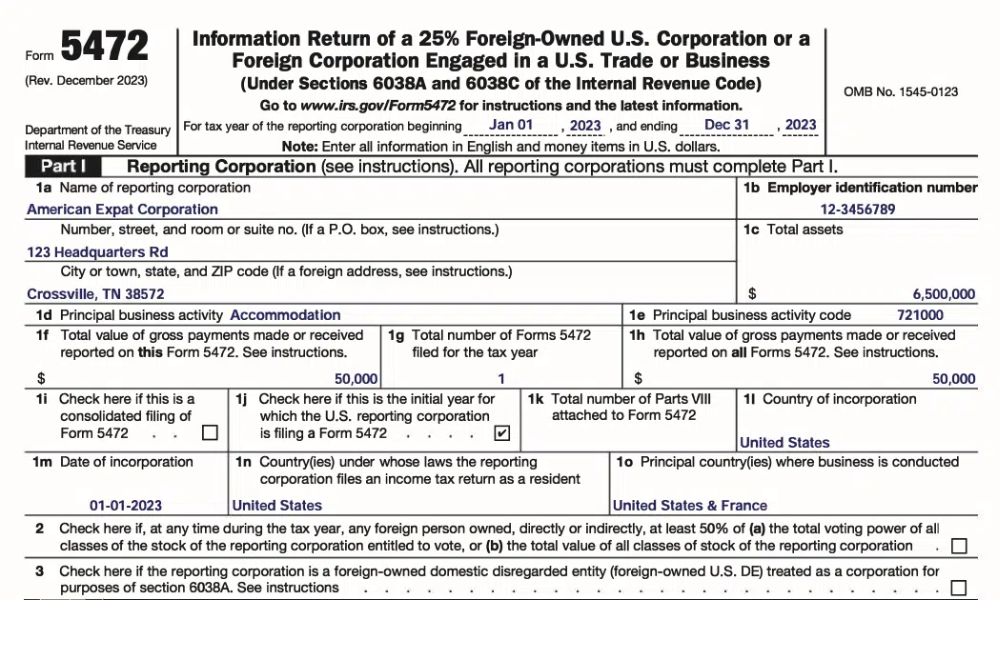
None of the UAE analysis above changes what the US side of the LLC owes the IRS. A single-member LLC owned by a non-resident is treated as a disregarded entity: no US federal income tax without US-connected activity crossing the ETBUS threshold, which is unlikely for a remote, UAE-based business with no US office or staff. But the filing obligation is unconditional: Form 5472 with a pro-forma 1120 is due every year, even with zero activity, and the penalty for skipping it is a flat $25,000. Read the full breakdown in US LLC tax for non-residents, it’s the page we point every client to before we ever talk about their home-jurisdiction tax picture, because the US filing obligation is the one piece that’s identical no matter which passport or which emirate you’re in.
What building this properly looks like
We’ve formed and maintained 120+ structures for non-resident founders since 2019: Dubai-based clients among them, mostly people whose revenue genuinely sits outside the UAE and who wanted dollar-native infrastructure without pretending it solved a UAE tax question it was never built to solve. The pattern that works: a US LLC for the US-facing or Stripe-settled side of the business, a UAE free zone entity (built with a UAE-specialist partner) if there’s real UAE-facing activity, and neither one asked to do the other’s job.
The mistake we see most often isn’t the wrong entity: it’s the entity chosen before anyone asked where the substance and the clients actually are. Get that order right and both structures are simple. Get it backwards and you end up defending a free zone company’s 0% status with no real premises behind it, or explaining to a US client why your invoicing entity has never filed a US return.
Start with the honest assessment
Eleven questions, and we tell you whether a US LLC fits your Dubai-based situation, including the version where the honest answer is “you need a UAE entity for this part, and a US LLC for that part, and here’s why.” Get your assessment →
If you want the numbers first, see pricing. If you already have a US entity and it wasn’t built with your UAE residency in mind, we also handle that: see switch your LLC.
Frequently asked questions
If UAE personal tax is 0%, why would I need a US LLC at all?
Because the 0% personal rate answers a different question than the one a US LLC answers. Personal tax residency in the UAE tells you what you owe on income once it reaches you. A US LLC is about how you invoice, get paid, and appear to US-based or Stripe-processed clients: dollar rails, a Delaware-adjacent entity structure that enterprise clients recognise, and no UAE trade licence or visa sponsorship obligation if you don't need local presence. Plenty of Dubai residents need neither. Some need both.
Does a UAE free zone company avoid corporate tax entirely?
Not automatically. Since June 2023 the UAE has had a federal 9% corporate tax. Free zone entities can still reach 0% on their qualifying income, but only as a Qualifying Free Zone Person: which means maintaining adequate substance in the UAE, keeping income inside the qualifying categories, passing a de minimis test on non-qualifying revenue, and not electing into the standard regime. Miss any of those and the 9% rate applies to your taxable income above the AED 375,000 threshold, and in some failure cases it applies to everything, not just the excess.
Is a US LLC just a way to avoid the UAE's corporate tax?
No, and treating it that way is how structures get fragile. If your business is genuinely UAE-facing (UAE clients, UAE staff, a UAE office), the UAE is where the substance and the tax exposure both sit, LLC or not. A US LLC changes your invoicing and banking infrastructure; it does not relocate a UAE business's tax base. Where it does something real is for revenue that is genuinely earned outside the UAE (US or international clients, remote services, Stripe settlement) routed through an entity built for that, without pretending a UAE operation is something it isn't.
Will a US LLC cause problems with UAE banks or my residence visa?
Not inherently, but it needs to be explained correctly. A US LLC you own does not replace or interfere with your UAE residence visa, and it isn't a UAE trade licence: if you need to invoice UAE clients or sponsor visas locally, you still need a UAE entity for that. What it can complicate is your UAE bank's questions about your income sources if you're vague about the structure. Being precise about what the LLC does, and doesn't do, is the whole difference between a clean file and a flagged one.
What about opening a US bank account while I'm based in the UAE?
Some US banking partners treat the UAE as a higher-friction jurisdiction for card issuance or account opening, and policies shift often enough that anything specific we wrote today could be outdated by the time you read it. What doesn't change: a well-prepared file (clear business description, clean source of funds, a real operating agreement) gets a materially better reception than an unexplained UAE address on a generic application. We prepare the file and work the relationships; nobody can promise you an approval. See our full picture on U.S. banking for non-residents.
Do you handle the UAE free zone side yourselves?
No, and we'd rather tell you that plainly than pretend otherwise. Our depth is the US entity: formation, EIN, compliance, and US banking access. For the UAE free zone or mainland decision (which zone, which licence category, whether you clear the substance test), that's a conversation for a UAE corporate services provider, and we'll say so directly rather than guess at a jurisdiction we don't practise in day to day.