A US LLC for Traders and Investors
This is the one profile where our honest answer is usually no. If you trade your own capital, a US LLC very rarely does what the people selling it say it does.
Most pages on this site explain how a structure helps. This one mostly explains why it does not, because in six years of doing this the trading profile is where the gap between expectation and reality is widest, and where the marketing is loudest.
The pitch usually goes: hold your brokerage account inside a US LLC, and because a non-resident LLC pays no US federal income tax, your trading gains are untaxed. Every element of that sentence is either irrelevant or wrong for someone trading their own money.
The rule that actually governs this: a single-member LLC is transparent. The gains are yours, taxed where you are tax resident, under that country’s rules. A wrapper does not change the owner of the income, and the entity’s jurisdiction does not override your residency.
Why the entity does so little here
Look at what an LLC actually solves for other profiles, and check each against a trading activity:
- Payment rails and invoicing. You do not invoice anyone. The market pays you through a broker.
- Vendor onboarding and procurement. There is no client running a vendor approval process.
- Payment processor access. You are not processing customer payments.
- Liability separation from customers. You have no customers to be liable to.
What is left is asset holding and, in some framings, privacy. Those are real considerations, and they are usually better served by other means than a US LLC formed by a non-resident with no other US connection.
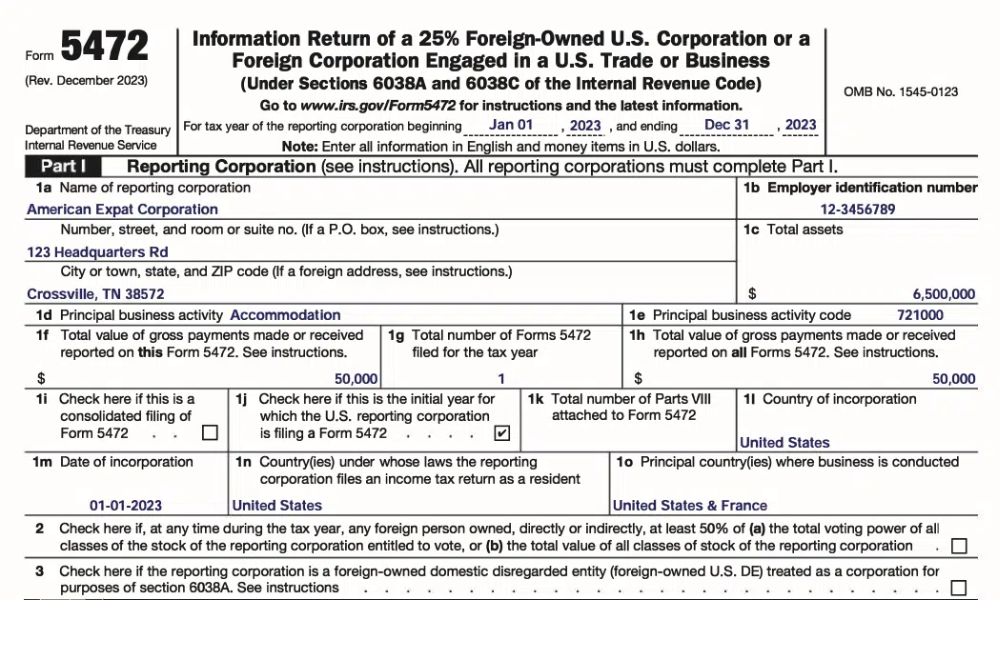
Meanwhile, the costs are unchanged: a registered agent, Form 5472 plus a pro-forma 1120 every year with a $25,000 penalty for missing it, and state filings where they apply. You take on the full compliance load of the structure and receive almost none of its operational benefits.
The US tax picture, stated carefully
For a non-resident individual not engaged in a US trade or business, the broad framework is that capital gains are typically outside US federal income tax, while US-source dividends are generally subject to withholding at source, potentially reduced by a treaty. Interest depends on its type. Spending substantial time physically in the US brings its own residency test into play.
Two things follow that people miss.
First, the withholding on dividends happens at the broker, on the basis of the beneficial owner’s documentation. A transparent US LLC in the middle does not automatically improve that position, and it can make the paperwork question harder rather than easier: which form, which claimant, which treaty article.
Second, and more importantly: none of this is where your tax bill comes from. Your country of residence taxes your gains under its own rules. If it taxes worldwide income, it taxes these gains, whether they sit in your name or in an entity you own. Some countries go further, with controlled foreign company rules that can attribute an entity’s undistributed profit to you directly. See tax for non-resident LLC owners for the framework.
Not sure how this applies to your case?
Eleven questions and we tell you whether the LLC fits, and if it does not, that too.
Where the structure question is actually decided: your residency
For traders, the variable that genuinely moves the numbers is not the entity. It is where you are tax resident, because that is what determines how your capital gains are treated.
That is a real decision with real consequences, and it is a life decision before it is a tax one. Some jurisdictions treat foreign-source capital gains differently from local ones; some have holding-period rules; some have wealth or exit taxes that matter more than the headline rate. We have written honestly about the six destinations we deal with most (Dubai, Portugal, Cyprus, Paraguay, Panama and Georgia), including what does not work about each.
If someone has sold you an LLC as the answer to a trading tax question, they have sold you a wrapper for a problem whose solution lives one level up.
The cases where it does fit
To be fair to the structure, three trading-adjacent situations genuinely justify an entity:
You manage other people’s money. Then you have clients, contracts, fee income and possibly regulatory obligations. That is a business, and it needs a proper legal home, plus advice well beyond what a formation provider offers.
Trading sits inside an operating business. If the company also sells something, invoices customers and takes payments, the entity earns its keep on that side and the trading is one activity within it.
There is a genuine multi-party or asset-holding reason. Several people contributing capital under an agreement need a vehicle and a document that defines what happens when they disagree.
And a fourth, related profile: if your income actually comes from prop firm payouts, or from teaching, signals or an education business built around trading, you are not in this category at all. That is contractual or customer income, and the analysis in US LLCs for course creators or for freelancers fits you better.
Opening a brokerage account in an entity’s name
If you have decided an entity is right for one of the legitimate reasons, this is the step where the plan meets reality, and it is harder than opening a personal account.
Not every broker accepts entity accounts from non-resident owners. Many that accept individual non-resident clients will not open for a foreign-owned LLC, or will do so only for certain entity types. This is worth confirming with the specific broker before forming anything, because a structure built for an account you cannot open is pure cost.
The documentation load is heavier. Expect the formation documents, the operating agreement, the EIN confirmation, evidence of beneficial ownership, sometimes a certificate of good standing, and identification for every person with control. All of it has to agree with itself.
The operating agreement gets read here. More carefully than almost anywhere else. A template that does not clearly establish who may open accounts and trade on the entity’s behalf is the thing that stalls the application.
Expect questions about source of funds. Moving capital into an entity account triggers the same scrutiny as any substantial transfer. Having a clear, documented answer ready is faster than assembling one under a compliance deadline.
Your existing positions may not transfer. Moving a personal portfolio into an entity account can be a disposal event depending on your country’s rules, with tax consequences that arrive in the year of the move. This is a question for your local adviser before you start, not after.
The pattern holds: the entity is easy to form and the account is the hard part, which is exactly backwards from how it gets sold.
The reporting that follows you home
The part that is genuinely yours to manage, and the part most likely to cause a problem.
Whatever the US does or does not tax, the country where you are tax resident has its own view of a foreign entity you own and a foreign account you control, and the disclosure obligations are usually independent of whether any tax is due.
Foreign entity ownership is commonly reportable. Many countries require you to declare an interest in a foreign company, on its own form, on its own deadline, with penalties for omission that are independent of the tax position.
Foreign accounts are commonly reportable. Often above a threshold, often annually, and the threshold is frequently lower than people assume.
Controlled foreign company rules may attribute the profit to you directly, whether or not you distributed anything. For a passive, investment-holding entity these rules bite more often than for an active trading business, which is precisely the wrong way round for this profile.
Information is exchanged automatically. Account information moves between jurisdictions under standard reporting frameworks. The practical implication is simple: assume your country will know about the account, and structure accordingly.
Records are your responsibility. Trade-level records, cost basis, currency conversion at the right dates. A broker statement in dollars is not a local tax filing, and reconstructing years of it retrospectively is expensive.
Foreign entity and account reporting obligations, CFC attribution and the tax treatment of transferring existing positions into an entity are entirely determined by your country of residence: this needs a local adviser before any structure is formed.
None of this argues against a structure. It argues against forming one without knowing what it obliges you to report, which is the situation most traders who arrive here are already in.
The four claims sold to traders, and what is actually behind them
This profile attracts more bad advice than any other on the site, so here are the specific claims, in the words they are usually sold in.
“A US LLC means your trading profits are tax free.” The half-truth underneath is that a non-resident trading securities for their own account is generally not treated as engaged in a US trade or business by virtue of that trading alone, so the trading gains are frequently outside the US net. What the claim omits is that the gains land in your country of residence, which taxes them under its own rules. Nothing was made tax free. The US simply was never the country charging you.
“Put the account in the LLC’s name and it becomes US-source.” This reverses how sourcing works. Where the account is held does not determine your personal tax position, and moving a personal brokerage account into a disregarded entity generally changes very little about the tax treatment while adding an annual filing obligation and a layer of paperwork.
“You will avoid the withholding on dividends.” US-source dividends paid to a non-resident are subject to withholding, and the rate depends on the treaty between the US and your country of residence rather than on whether an LLC sits in the chain. A treaty claim is made with the right form, correctly completed. It is not obtained by owning an entity.
“An LLC gives you trader tax status and lets you deduct everything.” The various elections and statuses that let active traders deduct expenses or mark positions to market are features of the US tax system for people inside it. Reaching for them as a non-resident whose gains are not US-taxable in the first place is answering a question you do not have.
The trading safe harbour, dividend withholding rates and any treaty position depend on your residency, your specific instruments and your pattern of activity: a trader with meaningful volume needs this confirmed by a US tax adviser and by an adviser in their country of residence, not by a landing page.
What your instruments change
Not all trading raises the same questions, and the differences matter more than the entity.
Listed equities and ETFs are the straightforward case, and the one the safe harbour is usually discussed around. The main US-facing question is withholding on dividends rather than on gains.
US-domiciled funds held by non-residents raise questions beyond income tax that a lot of traders never consider, including estate tax exposure on US-situs assets above relatively modest thresholds. This catches people out precisely because it has nothing to do with income and never comes up in trading discussions.
Derivatives, futures and options have their own characterisation rules and are not automatically covered by the same reasoning that applies to shares.
Crypto is the wild card. Treatment varies enormously by country of residence, the reporting regimes are tightening quickly, and the exchange relationship is more fragile than a brokerage relationship. An entity may help with the banking and exchange side and does very little on the tax side.
Property and property-backed instruments are a different question again, because real property has source rules of its own that the trading safe harbour does not touch.
The pattern: your instruments determine your exposure far more than your entity does, which is precisely why the entity-first advice is the wrong way round.
When a structure genuinely does help a trader
To be fair to the other side of the argument, there are real cases, and they are worth stating because we do build for them.
When trading is not the business. A founder with an operating company that also holds investments has a genuine structural question about where those investments sit. That is a real problem with a real answer, and it starts from the operating business rather than the portfolio.
When there are other people’s funds involved. The moment you manage money that is not yours, you are in a regulated activity in most jurisdictions and the questions are licensing questions before they are tax questions. An LLC is not a workaround for that and treating it as one is a serious mistake.
When the barrier is access rather than tax. Some traders want a US entity because a specific platform, broker or counterparty requires one. That is a legitimate operational reason, it is honest about what it is buying, and it is checkable in advance.
When there is a real partnership. Two or more genuine partners sharing capital and profit need a vehicle with an agreement that says who owns what. That is what an operating agreement is for, and it is worth doing properly.
Notice that none of these is “to pay less tax.” When someone arrives with that as the objective, the honest answer is that the structure is not the lever, and we would rather say it than sell around it.
What we will tell you
If you come to us trading your own capital and asking for an LLC to reduce tax, we will tell you it does not do that, and we will not take the fee. That is not a negotiating position. It is the same answer we have given consistently, and it is why the assessment has an output that says plainly that this does not fit, on screen, without asking for your email.
If after that you still want the entity for a reason you can articulate, we will build it properly: the right state, an operating agreement that reflects reality, an EIN without an SSN, and a compliance calendar so year one holds no surprises. Prices are published. But we would rather you kept the money.
Frequently asked questions
Will a US LLC let me trade without paying tax on my gains?
No, and this is the belief we spend most time correcting in this category. A single-member LLC is transparent for US federal purposes: gains flow to you personally, and your country of tax residence taxes them under its own rules for capital gains and foreign income. The entity adds a wrapper; it does not change who the income belongs to. Anyone selling this structure on a tax-free trading premise is describing something that does not work the way they say it does.
Do non-residents pay US tax on capital gains from US stocks?
The general rule is that capital gains of a non-resident individual not engaged in a US trade or business are typically not subject to US federal income tax, while US-source dividends are generally subject to withholding at source, at a statutory rate that a treaty may reduce. Interest treatment depends on the type of interest. There is also a substantial-presence dimension for individuals who spend significant time in the US.
This is a general framework, and the treatment of a specific instrument, your treaty position and any US presence needs confirming with a US tax adviser for your case.
Does holding the account through an LLC reduce the dividend withholding?
Generally not, and it can complicate the claim rather than simplify it. Withholding on US-source dividends is applied by the payer or the broker on the basis of the beneficial owner's status and the documentation on file. Inserting a transparent US entity between you and the account does not by itself create a better treaty position, and it introduces questions about which form applies and who the treaty claimant is. If your goal is the lowest defensible withholding rate, the work is in your documentation and treaty entitlement, not in the wrapper.
Is there any case where a trader genuinely benefits from an LLC?
Yes, three that we see stand up. First, if you manage money for other people, you are running a business (with contracts, clients and potential regulatory obligations) and the entity question becomes real and serious. Second, if trading is one activity inside an operating business that also has customers and invoices. Third, if there is a genuine liability or asset-holding reason, such as multiple partners contributing capital under an agreement that needs a legal home. Trading your own capital alone is not on this list.
What about a prop firm payout or an educational business built around trading?
Those are different profiles, and they often do fit. A prop firm payout is typically contractual income from a company, and an education or signals business has customers, invoices and payment processing: all the things an entity helps with. If that is what you actually do, look at the freelancer or course creator analysis instead, because the structure follows the activity rather than the label.