A US LLC for Amazon FBA Sellers
Fulfilment by Amazon means your goods live in US warehouses. Everything that makes FBA operationally easy is the same thing that makes the tax question harder than for any other e-commerce seller.
Most of what is written about US LLCs for non-residents rests on one comfortable assumption: that you have nothing physical inside the United States. No office, no staff, no property. On that basis the conclusion is usually that there is no US trade or business, so no US federal income tax, just an annual information filing.
FBA breaks the assumption. Your inventory is property, it is inside the US, and it is being used in your business. That does not automatically mean you owe US tax, but it does mean you no longer get to skip the analysis, and we would rather say so than sell you the comfortable version.
The rule that actually governs this: the ETBUS question is about people and property in the United States, not about American customers. FBA puts property there. That moves your case from “generally straightforward” to “needs a US tax adviser’s opinion on your facts,” and no honest provider should tell you otherwise.
What makes FBA structurally different
You do not choose your state footprint. Amazon distributes inventory across fulfilment centres according to its own logistics, and moves it. Sellers routinely discover their goods sit in states they have never thought about. Since sales tax nexus can follow inventory location, your compliance map is drawn by someone else’s algorithm.
Marketplace facilitator rules help, and only so far. For sales made through Amazon’s marketplace, facilitator laws generally shift collection and remittance to Amazon. That is a genuine simplification. It does not necessarily resolve registration obligations in states where your inventory physically sits, and it does nothing for sales you make through your own store. See US LLCs for e-commerce for how the systems separate.
The federal analysis is genuinely contested. There is a real, unresolved debate about how FBA inventory interacts with the ETBUS test, complicated further by treaty positions where a treaty applies to your country of residence. Anyone who tells you the answer with total confidence, in either direction, and without asking about your specific setup, is telling you what is convenient rather than what is true.
What the entity does for you regardless
Setting the contested part aside, the practical case for the structure is straightforward:
- A US business account for Amazon disbursements, on US rails, without an international transfer on every payout. Banking is the piece most sellers underestimate.
- An EIN, which US suppliers, freight forwarders and prep centres expect before they will deal with you on business terms.
- A resale certificate position for buying inventory without paying sales tax on goods intended for resale.
- Liability separation between a product business (with genuine product liability exposure) and your personal assets.
- A seller account whose legal entity does not need changing later, which is a real operational saving given how disruptive that change is once an account is established.
Not sure how this applies to your case?
Eleven questions and we tell you whether the LLC fits, and if it does not, that too.
The honest version of the compliance load
Plan for all of this, and budget for professional help on the parts that need it:
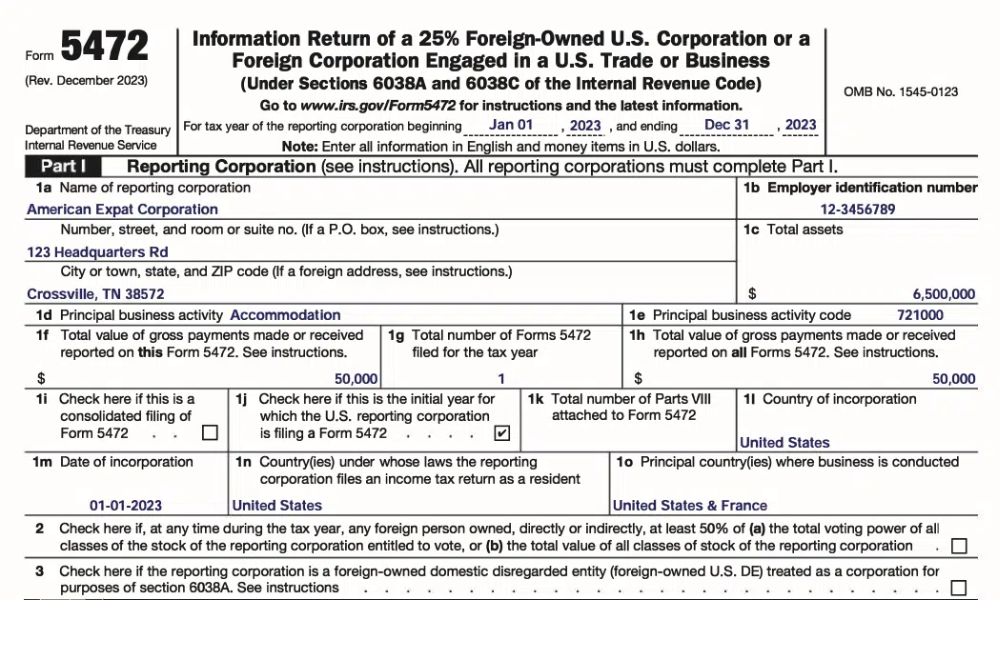
- Annual federal information filing: Form 5472 plus pro-forma 1120, $25,000 penalty for missing it, due regardless of profit.
- A real ETBUS determination: not a blog post, not a forum thread. An opinion from a US tax adviser on your facts, revisited as your business changes shape.
- State registration where inventory sits, reviewed on a schedule rather than when a notice arrives.
- Inventory-by-state monitoring, because it changes without your involvement.
- Registered agent and state filings in the state of formation.
- Books that survive scrutiny, including the related-party transactions the 5472 exists to report.
This is more than most providers describe, and it is a large part of why we do not sell FBA sellers a $199 formation and wish them luck. If your plan does not include a US tax adviser, the plan is incomplete.
When we tell FBA sellers no, or not yet
You have not launched. Product validation first. Structure second. Forming an entity around a product that has not sold anything is a fixed cost with no revenue attached to it.
You are testing with a handful of units. Below roughly $20,000–25,000 a year, the combined cost of the structure, the filings and the advice this profile genuinely needs is hard to justify. Test on a simpler footing, then structure when the volume warrants it.
You want the LLC specifically to avoid US tax. If that is the goal, we are the wrong provider, because FBA is exactly the profile where that pitch is least defensible. What we can do is make sure the structure is correct, the filings are made and the analysis is done by someone qualified to do it.
The assessment asks directly about inventory and US presence, and routes FBA answers differently for this reason. You get the full result on screen, including where it says your case needs specialist advice before anything gets formed.
Paying suppliers, and why the entity helps more here than anywhere else
For most profiles on this site the US LLC is about getting paid. For FBA it is at least as much about paying, and that is an underrated part of the case.
Manufacturers take you more seriously as a company. A supplier evaluating a new buyer is assessing whether you will still exist in six months. An entity with a name, an EIN and a dollar account reads differently from an individual sending a wire from a personal account, and it changes the terms you can negotiate.
Dollar-to-dollar payments avoid a conversion. Most manufacturing is quoted in dollars. If your money sits in euros or pesos, every purchase order pays a spread. A dollar account removes that on the largest single cost in the business.
Payment terms are the real prize. New buyers pay everything upfront. Established ones negotiate deposits and balances, and eventually terms. Getting from full-prepayment to thirty percent deposit changes your working capital position more than almost anything else you can do, and being a credible business entity is part of how you get there.
Trade assurance and escrow work better with matching documents. Where a marketplace or escrow service sits between you and the supplier, the name on the account, the entity and the shipping documents all need to agree. Mismatches cause holds at precisely the moment your container is on the water.
The unglamorous summary: FBA is an inventory business, inventory is bought in dollars, and the structure that makes buying easier is worth as much as the one that makes selling easier.
Brand registry, trademarks and the name on the entity
An area where FBA sellers make an early decision without realising it is a decision.
Amazon’s brand protection tooling generally requires a registered trademark, and the trademark application requires an applicant: which can be you personally or your entity. Whichever you choose is the owner, and changing it later is an assignment with paperwork and cost rather than a settings change.
Three things follow.
Consistency across the stack. Trademark holder, seller account, entity and bank account should tell the same story. When they do not, brand registry applications and account verifications stall, and the support process for resolving it is slow.
The entity is usually the right owner for a business you might sell. An FBA business is a genuinely saleable asset, and buyers want the brand and the seller account to transfer cleanly. A trademark owned personally while everything else sits in the entity is a complication discovered during diligence, which is the worst moment to discover anything.
Your entity name and your brand name do not have to match, and usually should not. One entity can hold several brands. Naming the LLC after your first product is a constraint you will resent by the third one.
None of this is urgent in month one. All of it is much cheaper to get right in month one than in year three.
Expanding to a second marketplace changes the whole picture
The point at which FBA structures most often stop fitting.
Selling into a second region is not a bigger version of the same business. It typically means a separate marketplace account, local VAT or GST registration, a different importer-of-record question, local product compliance and labelling rules, and a warehouse network in another jurisdiction creating its own connections.
Two errors are common and both are avoidable.
Assuming the US entity covers it. A US LLC selling into the EU does not thereby become an EU-compliant seller. VAT registration, an EORI number where required, and the importer-of-record role are separate obligations that attach because of where you are selling and importing, not because of where you incorporated.
Assuming you need a second entity. Sometimes you do. Often you do not, and the additional entity adds annual cost and complexity to solve a problem that registration alone would have solved. This is genuinely case-by-case and it is worth asking before forming rather than after.
EU and UK VAT registration, importer-of-record obligations and marketplace deemed-supplier rules for a non-EU seller vary by market and change frequently: confirm with an indirect tax adviser in the target region before expanding.
The right time to ask these questions is while the expansion is a plan. The wrong time is when the first shipment is held at a border.
Inventory is the nexus, and it moves without asking you
The single fact that separates FBA from every other e-commerce model: your stock creates a taxable connection in whichever state it sits, and Amazon decides which state that is.
You send a shipment to one fulfilment centre. Amazon redistributes it across its network according to its own forecasting. You now have inventory in states you did not choose, did not know about, and cannot control. Each of those is a potential physical nexus for sales tax purposes.
Three practical consequences.
Your inventory reports are tax documents. Amazon publishes reports showing where your stock is held. Most sellers never open them. They are the evidence base for any nexus question, and they are also the first thing anyone reviewing your position will ask for. Pull them periodically and keep them.
Marketplace facilitator rules cover most of the damage. Amazon collects and remits sales tax on marketplace sales in the states that require it, which removes the bulk of the collection burden. What it does not automatically remove is the registration question in states where holding inventory creates a filing obligation independent of who collected the tax.
The seam is your own store. If you also sell direct through Shopify or your own site, those sales are not covered by the marketplace’s collection, while your FBA inventory may have created nexus in the same states. That combination (marketplace inventory plus direct sales) is where FBA sellers most often end up out of compliance without a single bad decision.
The full picture, including what marketplace facilitator laws did and did not resolve and why FBA inventory raises a separate federal question, is in Amazon FBA sales tax for non-resident sellers.
Whether inventory alone creates a registration obligation, and in which states, is unsettled and varies by state: an FBA seller with meaningful volume needs a nexus study from a US sales tax specialist rather than a general rule.
Amazon’s own verification, which is separate from everything else
Worth its own section because sellers routinely conflate it with banking and formation, and it has its own rules.
Amazon runs identity and business verification on seller accounts, and it re-runs it. The documents it wants (proof of the entity, proof of the beneficial owner, a bank account in a supported location, a utility bill or bank statement matching an address) need to be internally consistent and consistent with what you told the bank. A name spelled differently, an address that does not match, or an entity whose good standing has lapsed can suspend an account that has been trading happily for two years.
Two rules that prevent most of the pain. Change one thing at a time. Switching the entity, the bank account and the address in the same week is a reliable way to trigger a review. Never let the entity fall out of good standing. It is the cheapest thing on this page to maintain and one of the most expensive to have lapse, because the account suspension does not care that the underlying fix takes a week.
A suspended seller account with inventory sitting in warehouses and storage fees accruing is the worst version of this business, and it is almost always caused by paperwork rather than by anything commercial.
Cash flow, disbursements and the money that is not liquid
FBA has a working capital shape that interacts badly with a thin structure.
You pay for inventory upfront, you pay for shipping and prep, the goods sit in warehouses accruing storage fees, and you get paid on a disbursement cycle rather than per sale. Your money is in three places at once (in stock, in transit, and in the pending balance) and only the third is available.
That matters structurally for two reasons. A reserve is not optional. Amazon can hold funds, extend the disbursement schedule for new accounts, or freeze a balance during a review. A business with no buffer treats a routine hold as an emergency.
And the annual obligations do not pause for a bad quarter. The registered agent renews, the state filing falls due, and the Form 5472 is owed whether or not the year went well. Budget them as fixed costs at the start of the year, because they are the ones people skip when cash is tight and they are the most expensive to skip.
Where we fit
We form the entity properly: the right state, an operating agreement that matches reality, an EIN without an SSN, a banking file prepared before the first application, a year-one compliance calendar. We tell you plainly which parts of an FBA case need a US tax adviser rather than a formation provider, and we do not pretend the contested part is settled. That is the whole offer, at published prices, starting with the assessment.
Frequently asked questions
Does storing inventory in Amazon's US warehouses make my LLC taxable in the US?
It makes the question live, which is different from answering it, and any provider giving you a confident yes or no without looking at your facts is guessing. The federal test is whether you are engaged in a US trade or business with income effectively connected to it. Inventory held in the United States for sale is US property being used in your business, and that is materially closer to the line than a store shipping from abroad. Some analyses also weigh the role of the fulfilment provider, the degree of your activity in the US, and any treaty position available to you.
The ETBUS treatment of FBA inventory is genuinely contested territory and turns on your specific facts: this needs a US tax adviser's opinion on your case before you scale, not a general article, including this one.
Amazon collects sales tax for me. Does that mean I have nothing to do?
It means less to do, not nothing. Marketplace facilitator laws generally put the collection and remittance obligation for marketplace sales on Amazon rather than on you. What that does not automatically resolve is state registration where you hold inventory, sales you make outside the marketplace through your own store, and the record-keeping states expect from sellers with goods sitting in their jurisdiction. Treat facilitator collection as covering one channel, not as a blanket exemption.
I cannot control which states Amazon stores my inventory in. How do I manage nexus?
You manage it by knowing where the goods are, which Amazon reports, and by treating the list as an operational input rather than a surprise. Inventory placement is Amazon's decision and it changes; that is precisely why FBA sellers end up with a state footprint they never chose. The practical approach is to pull the inventory-by-state data regularly, review it against each state's rules with someone who does this professionally, and register where required rather than discovering it later.
Should I form the LLC before or after I start selling on Amazon?
Before, if you are going ahead, but only after you have decided you are going ahead. Amazon's seller account verification is easier when the entity, the EIN and the bank account are consistent from the start; changing the legal entity behind an established seller account is a well-known operational headache. That said, forming an entity before you have validated the product is a cost with no return. The order we recommend is: validate, then structure, then scale.
Is a US LLC even the right entity for an FBA business, or should it be a corporation?
For most single-owner non-resident sellers, an LLC remains the workable answer, but this is exactly the profile where the question deserves a real adviser rather than a default. If the analysis concludes you have effectively connected income, the compliance and rate picture changes and the entity choice interacts with your treaty position and your home-country rules. That is a decision to make with a US tax adviser looking at your numbers, not one to pick from a comparison table.