A US LLC From Cyprus: Fitting the LLC Around Non-Dom, SDC and the 60-Day Rule
Cyprus non-dom is one of the more genuinely favourable regimes in Europe, which is exactly why it rewards precision. Get the characterisation of your LLC’s income wrong, and the exemption you moved for doesn’t apply to it.
If you’ve relocated to Cyprus, or you’re mid-move, you likely already know the outline: non-domicile status, a 17-year exemption from Special Defence Contribution on dividends and interest, and a 60-day residency path that doesn’t require the standard 183 days elsewhere requires. What’s less often explained clearly is how a US LLC’s profit actually gets categorised once it reaches you as a Cyprus tax resident, and that categorisation, not the existence of the LLC, is what decides whether you’re inside the exemption or outside it.
The distinction that matters most: non-dom status doesn’t exempt income, it exempts specific categories of income (dividends and interest) from one specific tax, SDC. Salary, self-employment income, and active trading profit are taxed under ordinary Cyprus income tax regardless of non-dom status. Whether your LLC’s distributions land in the exempt category or the taxed one is a characterisation question, not a formality.
What non-dom actually exempts, and what it doesn’t
Cyprus’s non-domicile regime gives qualifying tax residents a 17-year exemption from Special Defence Contribution (SDC) on dividends and interest, with the option to extend that shield in five-year blocks for a lump-sum fee, per current guidance from Cyprus tax advisory practices tracking the 2026 reform of the regime. For someone whose income genuinely arrives as dividends or interest, that’s a real, substantial 0% outcome on two significant income categories.
What it does not touch: ordinary income tax (PIT) on salary, self-employment earnings, or active trading profit, which continues under Cyprus’s standard progressive rates whether you’re a non-dom or not. Non-dom is a shield around a specific pair of income types, not a general 0% wrapper around everything you earn.
Where the LLC question actually sits: how is the distribution characterised?
This is the part that gets skipped in generic “move to Cyprus, form a US LLC, pay nothing” content, and it’s the part that determines whether the plan works at all. A single-member US LLC is disregarded for US federal purposes: the IRS looks through it to you. Cyprus does not automatically inherit that US characterisation. What matters for Cyprus tax purposes is how a distribution from your LLC is actually characterised locally: as a dividend (potentially falling inside the SDC exemption under non-dom) or as active trading or self-employment income flowing through a foreign vehicle (taxed under ordinary PIT, with no non-dom relief available).
That characterisation depends on facts specific to you: whether you’re actively working through the LLC day-to-day (which points toward active/self-employment income) or holding it more as a passive investment vehicle distributing profit (which points toward dividend treatment), how the distribution is documented, and how the LLC’s activity is structured. For most founders reading this (people actively running a services business, an agency, or an e-commerce operation through their LLC), the honest expectation should be that at least part of that income looks more like active income than passive dividends to a Cyprus tax officer, whatever the label on the wire transfer says.This characterisation needs confirming in writing by a Cyprus tax adviser against your actual structure and activity before you rely on the dividend/SDC-exempt treatment: this is precisely the kind of determination that shouldn’t be assumed generically.
GESY: the contribution that survives the exemption
Even where SDC genuinely doesn’t apply (qualifying dividends and interest under non-dom), Cyprus’s General Healthcare System (GESY) contribution runs on a separate track and generally still applies to that income, commonly cited around 2.65%, typically with an annual cap on the contribution itself. Non-dom removes the SDC line item; it does not remove GESY. Founders who plan around “0% on my dividends” without accounting for GESY are usually off by a percentage point or two, which is a manageable gap, but only if you’ve actually planned for it rather than discovering it at filing time.Confirm the current GESY rate and cap figures with a Cyprus adviser, since healthcare contribution parameters are reviewed periodically and the figures here should be checked against the current year’s rules before relying on them.
Not sure how this applies to your case?
Eleven questions and we tell you whether the LLC fits, and if it does not, that too.
The 60-day rule: more workable from 2026, still conditional
Cyprus’s 60-day residency test lets you qualify as tax resident without meeting the standard 183-day rule, provided you meet several conditions cumulatively, in the same tax year:
- At least 60 days physically present in Cyprus.
- No more than 183 days in any single other country during that year.
- A business, employment, or directorship connection to a Cyprus tax-resident company.
- A permanent residential property in Cyprus, owned or rented, maintained throughout the year.
The material change from 1 January 2026: the additional condition that you must not be considered tax resident anywhere else has been removed. Where dual residency arises, it’s now resolved under the relevant double tax treaty’s tie-breaker rules rather than disqualifying you from the 60-day path outright. For a founder still unwinding tax ties elsewhere during a move, that’s a meaningfully more workable rule than the version that applied before, but it’s still a cumulative test, and missing any single condition means falling back to the standard 183-day rule instead.
What still has to be disclosed
Cyprus tax residency comes with worldwide-income reporting obligations, and a US LLC doesn’t sit outside that picture because it’s American. Foreign bank accounts connected to income you’re declaring, and the LLC’s activity itself, need to be reflected correctly in your Cyprus filings: the specific forms and thresholds depend on your filing category and are worth confirming directly with a Cyprus accountant rather than assumed from a US-centric or UK-centric guide that’s never dealt with the Cyprus Tax Department.
Where a US LLC still earns its place
None of the characterisation nuance above means a US LLC is the wrong structure from Cyprus: it means the reason for forming one has to be accurate. Where it holds up:
- USD-native invoicing and banking for international or US-facing clients, with an entity structure that reads correctly to enterprise counterparties.
- Liability separation and a real operating agreement, rather than running everything as an unincorporated freelancer with a Cyprus tax file and nothing else.
- A clean, low-cost, boring entity (roughly $60 a year in Wyoming) that doesn’t raise questions anywhere, precisely because it isn’t trying to do anything clever.
What it doesn’t do: automatically convert your working income into SDC-exempt dividends by virtue of being a foreign LLC. That conversion, if it happens at all, happens through how Cyprus characterises your actual distributions, and that’s a determination for a Cyprus adviser on your specific facts, not a default outcome of forming a US entity.
A quick gut-check before you form anything
A US LLC is probably a good fit if:
- Your revenue comes mainly from clients or platforms outside Cyprus, and you want dollar-native invoicing and banking.
- You want liability separation and a proper operating agreement rather than trading as an unincorporated individual.
- You’re structuring for banking and credibility, and treating any SDC benefit as something to confirm with a Cyprus adviser, not something you’re assuming in advance.
It needs a Cyprus adviser’s sign-off before you rely on it if:
- Your plan depends on LLC distributions being treated as SDC-exempt dividends, and nobody Cyprus-qualified has confirmed that characterisation for your actual activity.
- You’re actively working through the LLC day to day (consulting, running an agency, freelancing) which tends to read as active income rather than passive dividend income to a Cyprus tax officer.
- You’re relying on the 60-day rule and haven’t checked all four conditions apply to your specific year, not just the headline “60 days.”
The through-line across both lists: the entity is easy to get right. The Cyprus characterisation of what comes out of it is the part worth paying an adviser for before you build a plan on top of an assumption.
The US side is identical, wherever you live
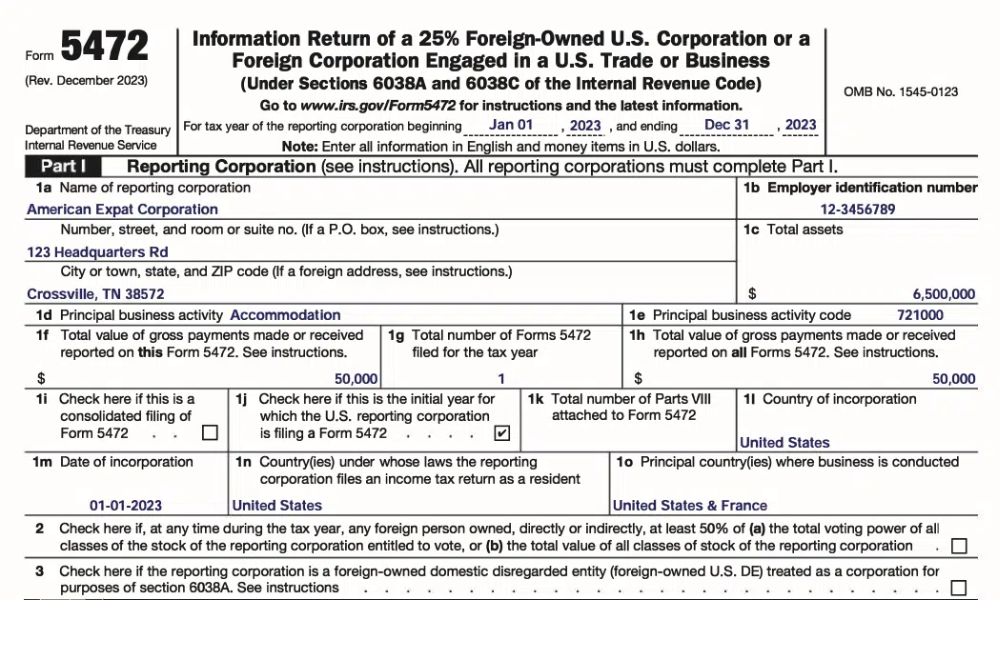
Everything above is the Cyprus half. The US half doesn’t change: a single-member LLC owned by a non-resident is disregarded for US federal purposes, generally owing no US federal income tax without US-connected activity crossing the ETBUS threshold, but always required to file Form 5472 with a pro-forma Form 1120 annually, even at zero activity, with a flat $25,000 penalty for skipping it. The complete mechanics sit in US LLC tax for non-residents, and the annual maintenance calendar is in US LLC compliance.
Where our own depth ends
Cheq Capital’s own fiscal depth is Spain and Latin America, plus the US side of any structure we build. The dividend-versus-active-income characterisation under Cyprus law, the exact current GESY parameters, and how a specific LLC’s profile interacts with SDC exemption are genuinely Cyprus-specialist questions, and we’re not going to manufacture false confidence on them. What we build correctly is the US entity (formation, EIN, compliance, and positioning for real banking) and we work alongside Cyprus tax advisers on the local side rather than guessing at it ourselves.
Start with the assessment
Eleven questions, and we tell you whether a US LLC fits your Cyprus-based situation, including the honest version where the next step is “get a Cyprus adviser to confirm how your distributions will actually be characterised before you rely on the SDC exemption applying to them.” Get your assessment →
If you already have a US LLC that was formed before your move to Cyprus, or by a platform that never asked about your tax residency at all, see how we take over an existing structure. If you want the numbers first, see pricing.
Frequently asked questions
Does Cyprus non-dom mean I pay 0% on everything from my US LLC?
No, and this is the single most common misunderstanding we see. Non-dom status exempts you from Special Defence Contribution (SDC) on dividends and interest for up to 17 years: that's genuinely 0% on those two income categories. It does not exempt salary, self-employment income, or active trading profit, which are taxed under Cyprus's ordinary progressive income tax regardless of non-dom status. Whether your LLC's profit lands as the exempt kind or the taxed kind depends entirely on how it's characterised, and that characterisation is exactly the point to get confirmed before you rely on any general description, including this one.
How does Cyprus actually characterise money coming out of a US disregarded LLC?
This is the genuinely technical question, and it's one we won't guess at generically. A single-member LLC is disregarded for US purposes, but Cyprus doesn't automatically inherit that US characterisation: whether a distribution from your LLC is treated by the Cyprus Tax Department as a dividend (potentially SDC-exempt under non-dom) or as active trading/self-employment income (taxed under ordinary PIT, no non-dom exemption) depends on facts: how the LLC is structured, whether you're actively working through it or holding it as an investment vehicle, and how the distribution is documented.
Get this characterisation confirmed in writing by a Cyprus tax adviser for your specific LLC and activity before assuming the dividend treatment applies.
What is GESY and why does it apply if my dividends are tax-exempt?
GESY is Cyprus's General Healthcare System contribution, and it runs on a separate track from income tax and SDC. Even income that's fully exempt from SDC under non-dom status (like qualifying dividends and interest) is generally still subject to a GESY contribution, commonly cited around 2.65%, typically subject to an annual cap on the contribution amount. Non-dom removes the SDC line; it doesn't remove GESY.
Confirm the exact current GESY rate and cap with a Cyprus adviser, since healthcare contribution parameters are adjusted periodically.
What changed with the 60-day residency rule in 2026?
The 60-day rule lets you qualify as a Cyprus tax resident without meeting the standard 183-day test, provided you meet a set of conditions in the same tax year: at least 60 days physically in Cyprus, no more than 183 days in any single other country, a business, employment, or directorship connection to a Cyprus tax-resident company, and a permanent residential property in Cyprus that you own or rent. As of 1 January 2026, the additional condition that you must not be tax resident anywhere else no longer applies: dual-residency conflicts are now resolved under the relevant tax treaty's tie-breaker rules instead of disqualifying you outright. This makes the rule more workable for founders who still have some residual tax connection elsewhere during a transition.
Do I need to declare my US LLC and its bank account to the Cyprus Tax Department?
Yes. As a Cyprus tax resident, your worldwide income and relevant foreign holdings need to be reflected in your Cyprus tax filings, and foreign bank accounts tied to income you're declaring are part of that picture. The specific disclosure mechanics depend on your filing category and should be confirmed with a Cyprus accountant: the point that doesn't change is that 'the account is American, so Cyprus doesn't need to know' is not a safe assumption.
Does a US LLC still make sense if I already have Cyprus non-dom status?
Often, yes, for the same reason it makes sense elsewhere: USD-native banking, an entity structure international clients recognise, and operational separation from your personal finances. What it isn't is a way to convert active income into the SDC-exempt dividend category by relabelling it. If the plan only works because a Cyprus adviser hasn't yet looked at how your specific distributions will be characterised, that's the conversation to have before forming anything, not after.