A US LLC From Portugal: What Changed After NHR Closed, and What It Means for the Entity
Portugal in 2026 is not the Portugal of the NHR-era blog posts still ranking on Google. If you’re planning around a US LLC and a regime that no longer exists, the sequencing is about to go wrong.
You moved to Portugal, or you’re planning to, for reasons that had little to do with a spreadsheet: the weather, the pace, the residency path, maybe a partner who’s already there. Somewhere in the planning, someone mentioned NHR, someone else mentioned a US LLC, and the two ideas got bundled together as if they were one decision. They aren’t, and the gap between them is exactly where founders get an unpleasant surprise at filing time.
The rule that actually governs this: Portugal taxes its tax residents on worldwide income. A US LLC changes how you invoice and bank; it does not change that Portugal still wants to know about, and generally tax, what the LLC earns. The regime you’re on (or aren’t on) decides the rate and the exemptions, not the entity.
NHR is closed. IFICI is not its replacement, it’s a narrower successor
Classic Non-Habitual Resident status (the flat-rate, broad-exemption regime that made Portugal a magnet for remote entrepreneurs for over a decade) stopped accepting new applicants at the end of 2024, with only a limited transitional path for people who could document Portuguese ties established before the cutoff. If you’re reading this because you’re planning a move now, classic NHR is not available to you, whatever a five-year-old blog post says.
Its successor is IFICI: the Tax Incentive for Scientific Research and Innovation, sometimes marketed as “NHR 2.0.” The name is doing real work here: it is not a general remote-worker or entrepreneur regime. Eligibility is limited to highly qualified professionals working in specific strategic sectors (science, technology, health, green energy, R&D) typically employed by, or affiliated with, a qualifying Portuguese company, certified start-up, or research institution. Where it applies, IFICI offers a flat 20% rate on the qualifying Portuguese income for ten years, non-renewable, per the Portuguese Ordinance 352/2024/1 and PwC Portugal’s guidance.
Most founders running an online services business, an e-commerce operation, or a freelance consultancy through a US LLC do not fit that profile. That’s not a reason to avoid Portugal: it’s a reason to plan as a standard Portuguese tax resident rather than assuming a special regime will apply, and to get that assumption corrected before it shapes a structuring decision.
How Portugal actually characterises a US LLC’s profit, and why “transparent” is the wrong word to use here
This is the part that catches out founders who did their reading on US tax forums and assumed the same logic travels. In the United States, a single-member LLC owned by a non-resident is a disregarded entity: the IRS looks through it to you. It’s tempting to assume Portugal does the same thing. It generally doesn’t.
Portuguese tax authorities have not accepted, as a general matter, that US pass-through treatment transposes automatically into Portuguese tax transparency. In practice, what a US LLC distributes to a Portuguese tax resident is typically characterised domestically as a form of capital income, rather than being treated as if the resident had earned the underlying trading profit directly and personally. That distinction matters for rate, for timing, and for what paperwork substantiates the position, and it needs testing against your specific facts by a Portuguese accountant, not assumed from a general description, including this one.
There’s a second layer that matters even more for founders who like to reinvest rather than distribute: Portugal’s controlled foreign company (CFC) rules. Where a Portuguese tax resident controls a foreign entity (commonly a 25% or higher threshold, alone or together with related parties) and that entity’s effective tax rate is meaningfully below what Portuguese corporate rules would produce, Portugal can impute the entity’s undistributed profits to the resident and tax them directly. A single-member US LLC, owned outright by one Portuguese resident, sitting at or near $0 US federal tax because there’s no ETBUS, is a plausible fit for exactly that test.The precise application of CFC imputation to a given LLC’s ownership structure and activity depends on Portuguese CIT rules under Article 66 and needs case-by-case confirmation with a local adviser: this is not a claim to rely on without that check.
The honest summary: don’t structure around the idea that a US LLC is “transparent” in Portugal the way it is in the US. It generally isn’t, and building a plan on that assumption is how a clean-looking structure turns into a correction letter two years in.
Not sure how this applies to your case?
Eleven questions and we tell you whether the LLC fits, and if it does not, that too.
What still has to be disclosed, whichever regime you’re on
Regardless of NHR, IFICI, or the standard regime, Portuguese tax residents have a standing obligation to disclose foreign bank accounts. That happens in Annex J, Section 11 of the annual Modelo 3 IRS return: IBAN, bank, and country, for every foreign account, even ones that earned nothing and held nothing all year. It’s a formal disclosure requirement, separate from the tax question: not reporting the account is its own problem, independent of whether tax was owed on what moved through it.
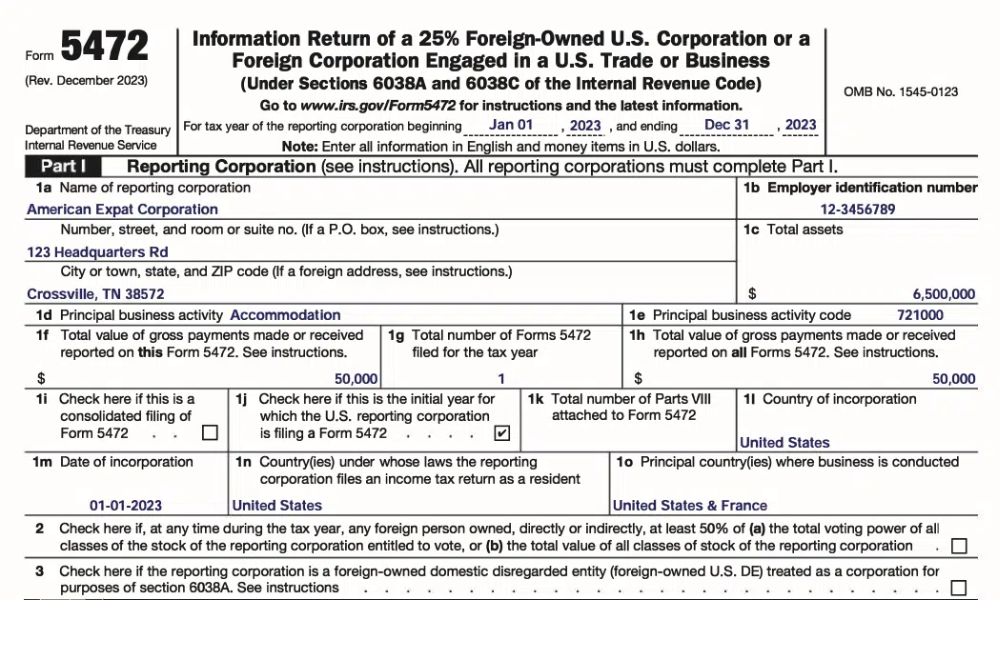
If your LLC has a US bank account or a fintech account like Mercury or Wise, and you’re a Portuguese tax resident, that account belongs in Annex J. This is one of the more commonly missed steps we see in inherited structures: founders who formed the LLC correctly, filed Form 5472 on the US side correctly, and simply never told their Portuguese accountant the account existed.
Where a US LLC still earns its place, honestly
None of the above means a US LLC is the wrong move from Portugal: it means the reason for forming one needs to be accurate. Where it genuinely helps:
- USD-native invoicing and banking for clients who pay in dollars or expect a US-facing entity: cleaner than routing everything through a Portuguese company for a business that’s mostly serving US or international clients.
- An entity structure that reads correctly to enterprise clients and platforms running vendor due diligence, without the friction of explaining a Portuguese unipessoal to a counterparty who’s never seen one.
- Liability separation and operational clarity between the business and your personal finances, which a well-drafted operating agreement supports in a way an informal freelance setup doesn’t.
- A clean bridge for founders mid-move: the LLC keeps operating identically whether you’re finishing a move to Portugal, already there, or reconsidering. It’s the Portuguese side of the equation, not the LLC, that determines what you owe.
What it does not do: exempt your worldwide income from Portuguese tax, substitute for a regime you no longer qualify for, or turn distributed or retained profit into something Portugal can’t see. Anyone pitching a US LLC as a way to make Portuguese tax residency “not matter” is selling a version of this that doesn’t survive contact with the Portuguese Tax and Customs Authority.
A quick gut-check before you form anything
Forming (or keeping) a US LLC probably makes sense if:
- Your clients are mostly outside Portugal: US or international B2B, platforms settling in USD, enterprise counterparties who expect a recognisable entity.
- You want clean liability separation and a real operating agreement, not an informal freelance setup.
- You’re clear-eyed that the LLC changes your invoicing and banking, not your Portuguese tax bill.
It’s the wrong tool, or at least not the whole answer, if:
- The main reason you’re considering it is to avoid Portuguese tax on income you’re already earning as a Portuguese resident: that’s a CFC and capital-income question the entity doesn’t solve.
- You genuinely qualify for IFICI through a qualifying professional activity, in which case the entity question is secondary to getting that application right.
- Nobody involved (you, your Portuguese accountant, whoever set up the LLC) has actually confirmed how distributions or retained profit get taxed in your specific case.
That last point is the one worth repeating: get a Portuguese accountant’s sign-off on the capital-income and CFC position for your actual numbers before treating any general description, including this page, as the final word.
The US side doesn’t change, wherever you live
Everything above is the Portuguese half of the picture. The US half is identical regardless of your residency: a single-member LLC owned by a non-resident is disregarded for US federal purposes, generally owing no US federal income tax without US-connected activity (ETBUS), but always required to file Form 5472 with a pro-forma Form 1120 every year, even at zero activity, with a flat $25,000 penalty for skipping it. The full mechanics, including how ETBUS actually gets triggered, are in US LLC tax for non-residents, and the annual maintenance calendar sits in US LLC compliance.
Where our own depth ends
We’ll say this the way we say it to every client, not just to Portuguese ones: Cheq Capital’s own fiscal depth is Spain and Latin America, and the US side of any structure we build. Portuguese tax characterisation of a US LLC (the capital-income treatment, the CFC imputation test, how IFICI or a residual NHR ruling interacts with an entity you already own) is genuinely specialist Portuguese tax territory, changing as recent rulings develop it, and we’re not going to improvise an answer to make ourselves sound more useful than we are. What we do build, correctly, is the US entity itself, and we work alongside Portuguese accountants rather than around them.
Start with the assessment, not the entity
Eleven questions, and we tell you whether a US LLC fits your Portuguese situation, including the honest version where the answer is “form it for the banking and the client-facing structure, and get your Portuguese accountant to confirm the capital-income and CFC position before you rely on anything else.” Get your assessment →
Already have a US entity that was formed before your move to Portugal, or by a platform that never asked about your residency? See how we take over an existing LLC, most inherited structures have at least one gap worth closing before a Portuguese accountant looks at them. If you want the numbers first, see pricing.
Frequently asked questions
Can I still apply for NHR if I move to Portugal now?
No. Classic NHR closed to new applicants at the end of 2024, with a narrow transitional window for people who could prove ties to Portugal established before the cutoff. If you're only now planning the move, classic NHR is off the table; the question is whether you qualify for its successor regime, IFICI, or whether you're simply a standard Portuguese tax resident.
Is IFICI the same thing as NHR, just renamed?
No, and treating it as a like-for-like replacement is the most common mistake we see. IFICI (the Tax Incentive for Scientific Research and Innovation) is deliberately narrower. It targets highly qualified professionals working in specific sectors (science, technology, health, green energy, R&D, certified start-ups), not the broad population of remote entrepreneurs and freelancers who used classic NHR. Most online business owners running a services or e-commerce business do not fit the IFICI profile, and applying for it without a genuine qualifying activity is not a strategy we'd sign off on.
Does Portugal treat my US LLC as transparent, the way the US does?
This is the single most important thing to get right, and the honest answer is: not automatically, and not the way many founders assume. Portuguese tax authorities have not generally accepted that US pass-through treatment of an LLC transposes into Portuguese tax transparency. In practice, this means amounts your LLC distributes to you as a Portuguese tax resident are typically characterised under Portuguese rules as a form of capital income, rather than being looked through as if you'd earned the underlying business profit directly. That characterisation, and its rate, needs confirming for your specific structure with a Portuguese accountant before you rely on any general description of it, including this one.
What about profits my LLC keeps and doesn't distribute?
This is where Portugal's controlled foreign company (CFC) rules come in, and it's a genuine risk to understand before structuring, not after. Broadly, if a Portuguese tax resident controls a foreign entity (commonly a 25%+ threshold, alone or with related parties) and that entity is taxed at a rate meaningfully lower than it would be under Portuguese corporate rules, Portugal can impute the entity's undistributed profits to the resident and tax them directly, whether or not a distribution was ever made. A single-member US LLC owned by a Portuguese resident is a plausible candidate for this test.
Confirm with a Portuguese tax adviser whether, and how, CFC imputation applies to your specific LLC's profile: ownership percentage, activity type, and effective US tax rate all affect the analysis.
Do I still need to report the LLC and its bank account to the Portuguese tax authority?
Yes. Portuguese tax residents must disclose foreign bank accounts in Annex J of the annual IRS return (Modelo 3): the IBAN, the bank, and the country, regardless of the balance or whether the account earned anything. This is a disclosure obligation, separate from whatever tax is ultimately owed on the LLC's income, and it applies whether you're on IFICI, transitional NHR, or the standard regime.
So does a US LLC still make sense if I live in Portugal?
Often, yes, but for infrastructure reasons, not tax-reduction reasons. Portugal taxes its residents on worldwide income regardless of where the entity sits, and the LLC does not make that go away. What it can still deliver: clean USD invoicing and banking for US or international clients, an entity structure enterprise clients recognise, and operational separation from your personal finances. If the primary reason you're considering an LLC is to reduce your Portuguese tax bill, that expectation needs correcting before you spend money forming anything.